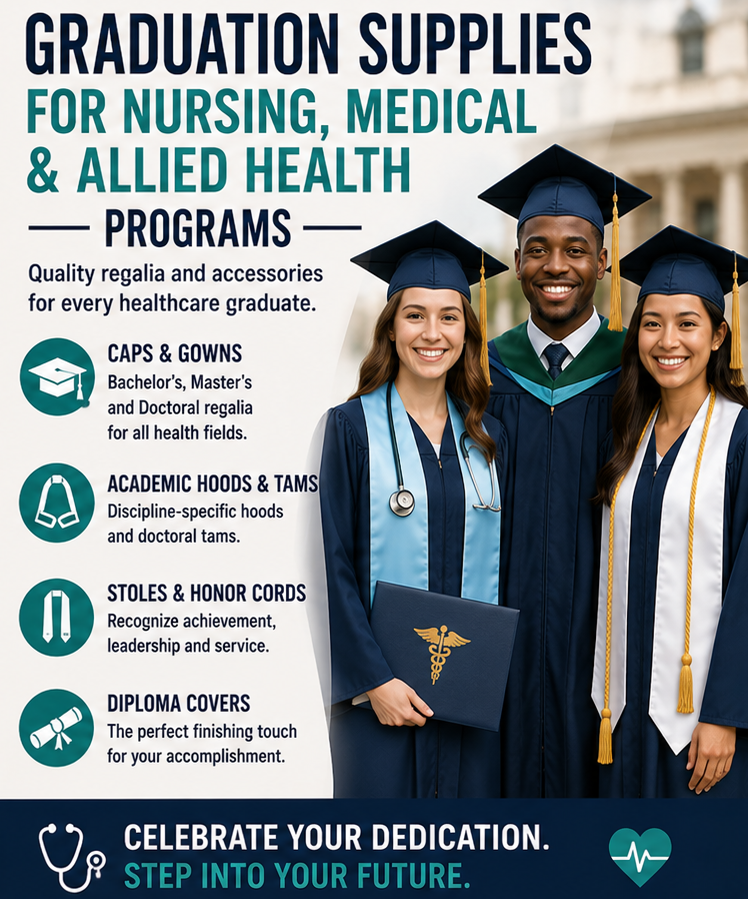
Graduation from a nursing, medical, or allied health program marks the completion of demanding academic and clinical training. Whether you are a student purchasing individual graduation cap gown regalia or a program administrator coordinating attire for an entire graduating class, planning ahead can make commencement preparation easier. From caps and gowns to academic hoods, tams, tassels, stoles, honor cords, and diploma covers, this guide explains the graduation supplies health profession programs may need.
Who Is This Graduation Supply Guide For?
Healthcare education includes many types of programs and degree levels. Graduation requirements can vary significantly, so students and administrators should confirm their institution’s official academic dress standards before purchasing.Programs May Include
- Nursing programs
- Medical schools
- Dental programs
- Pharmacy programs
- Physical therapy programs
- Occupational therapy programs
- Physician assistant programs
- Public health programs
- Respiratory therapy programs
- Radiologic technology programs
- Medical laboratory science programs
- Health administration programs
- Other allied health programs
What Graduation Supplies Do Healthcare Students Need?
The appropriate products depend on the graduate’s degree, institution, and ceremony. A certificate or associate-degree graduate may have different requirements from a bachelor’s, master’s, or doctoral graduate.Common Graduation Products
- Graduation gowns
- Mortarboard caps
- Doctoral tams
- Graduation tassels
- Academic hoods
- Graduation stoles
- Honor cords
- Diploma covers
- Graduation-year charms
Start With the Institution’s Regalia Requirements
Before ordering nursing or medical graduation regalia, determine exactly what the college, university, or healthcare program requires. Institutions may establish specifications for gown design, color, fabric finish, headwear, tassels, academic hoods, and permitted recognition accessories.Confirm Before Purchasing
- Degree level
- Required gown style
- Gown color
- Matte or shiny finish
- Mortarboard or tam requirement
- Tassel specifications
- Academic hood specifications
- Permitted stoles and cords
Graduation Gowns for Nursing Students
Nursing graduates may complete associate, bachelor’s, master’s, practice doctorate, research doctorate, or other programs. The correct graduation gown should therefore be selected according to the degree being awarded and the institution’s requirements rather than the profession alone.Bachelor’s Nursing Graduation Regalia
Students completing bachelor’s-level nursing programs may wear bachelor’s academic regalia consisting of an approved gown, mortarboard, and tassel.Master’s Nursing Graduation Regalia
Master’s graduates generally wear a master’s-style gown and academic hood in addition to the required headwear and tassel.Doctoral Nursing Graduation Regalia
Graduates completing doctoral nursing programs may require doctoral gowns, academic hoods, and approved doctoral headwear. Requirements should be confirmed with the institution because doctoral regalia can vary.Graduation Regalia for Medical Students
Medical graduates should follow the academic dress requirements established by their medical school or university. Depending on the ceremony and institution, doctoral-level regalia may include a doctoral gown, academic hood, and approved tam or mortarboard. Students should avoid selecting doctoral regalia based only on appearance because institutional specifications may determine important design details.Graduation Regalia for Allied Health Students
Allied health graduation regalia can cover a broad range of educational programs and degree levels. Some graduates may need a basic cap and gown set, while advanced-degree graduates may require master’s or doctoral academic attire. Program administrators coordinating a class order should separate students by degree level before determining product quantities.Bachelor’s, Master’s and Doctoral Regalia Are Different
One of the most important considerations when ordering for healthcare programs is recognizing that academic regalia changes with the degree level.Bachelor’s Regalia
Typically includes a bachelor’s-style gown, mortarboard, and tassel according to institutional requirements.Master’s Regalia
Generally includes a master’s gown with distinctive sleeves, appropriate headwear, tassel, and an academic hood.Doctoral Regalia
Doctoral attire is typically more elaborate and may include velvet detailing, distinctive sleeves, an academic hood, and doctoral headwear.Understanding Academic Hoods
An academic hood is an important component of master’s and doctoral regalia. It should not be confused with a graduation stole. Hood colors and construction may communicate information associated with the graduate’s degree discipline and institution. Because specifications can vary, students should verify the exact hood required rather than purchasing solely according to a general online color chart.Academic Hood Colors for Health Programs
Different academic traditions may associate colors with fields of study, but institutions determine the regalia they recognize for commencement. Nursing, medicine, pharmacy, dentistry, physical therapy, public health, and other health-related disciplines should not automatically be assumed to use the same hood color.Verify the Degree, Not Just the Department
Two graduates working in healthcare may earn different degrees requiring different academic hoods. Confirm the actual degree designation and institutional requirements before ordering.Doctoral Tams for Medical and Healthcare Graduates
Some doctoral graduates wear a doctoral tam rather than a traditional mortarboard. Tams can vary in design, material, number of sides, and tassel style. Before purchasing, confirm whether the institution requires or permits a tam and whether a particular design is specified.Graduation Tassels
Tassels are commonly attached to mortarboards and doctoral headwear. Color and style requirements may be established by the institution. Some tassels include a graduation-year charm. When ordering complete regalia sets, check whether the tassel and year charm are already included.Graduation Stoles for Nursing and Health Programs
Graduation stoles may be used to recognize approved programs, organizations, service, leadership, or other distinctions when permitted by the institution. Healthcare programs considering coordinated stoles for a graduating class should confirm university policies before ordering.Custom Graduation Stoles
When customization is permitted, a stole may potentially include approved program wording, graduation year, institutional colors, or authorized designs. Any school names, logos, seals, or other protected marks should be used only with appropriate authorization.Honor Cords for Healthcare Graduates
Graduation honor cords may recognize academic achievement, leadership, service, membership, or other established distinctions. Schools and programs distributing cords should define eligibility requirements and the meaning assigned to each color.Nursing Pinning Ceremony vs. Graduation Ceremony
Nursing students may participate in a pinning ceremony in addition to commencement. These are separate events and may have different attire requirements. Students should confirm what their nursing program expects them to wear for each event rather than assuming the same graduation attire is required for both.White Coat Ceremonies and Graduation Regalia
White coat ceremonies are also distinct from graduation. Medical and healthcare programs may hold white coat ceremonies at different stages of a student’s education. A white coat should not automatically be considered a substitute for academic regalia at commencement. Follow the institution’s instructions for each ceremony.Diploma Covers for Healthcare Programs
Diploma and certificate covers can be useful for commencement, recognition events, pinning ceremonies, and program presentations. Schools ordering covers should confirm the size and orientation of the document being presented before selecting a product.Bulk Graduation Supplies for Nursing Schools
Nursing schools and departments coordinating bulk graduation cap and gown orders should begin by determining the number of graduates and separating students by degree level.Information to Collect
- Graduate name
- Degree being awarded
- Graduate height
- Additional sizing information when required
- Gown style
- Gown size
- Headwear requirement
- Academic hood requirement
- Tassel requirement
- Approved accessories
Bulk Graduation Supplies for Medical Schools
Medical schools may have detailed requirements for doctoral academic regalia. Administrators coordinating an order should confirm the approved gown, hood, headwear, and tassel specifications before collecting student orders. Where multiple programs participate in the same commencement, maintain separate product lists for each degree.Bulk Graduation Supplies for Allied Health Programs
Allied health schools may graduate students from several programs during one ceremony. A centralized ordering system can help organize different gown styles, sizes, hoods, and accessories.Create Separate Lists by Program
For example, an institution may need to manage regalia separately for nursing, occupational therapy, physical therapy, public health, or other health programs depending on the degrees awarded.How to Collect Graduation Gown Sizes
Graduation gowns are commonly selected using height, with some manufacturers also considering weight, chest measurement, or additional sizing information. Provide students with the size chart for the exact product being ordered rather than asking them for ordinary clothing sizes.Individual Student Orders vs. Institutional Group Orders
Individual Orders
Individual purchasing can work well when students are responsible for obtaining their own approved regalia. Each graduate should verify institutional specifications before ordering.Institutional Orders
Schools and programs may prefer a centralized order when coordinating a large graduating class. This approach can simplify size collection, product consistency, distribution, and communication.How to Plan a Healthcare Program Group Order
Step 1: Determine the Graduate Count
Create a confirmed list of participating graduates.Step 2: Separate Students by Degree
Identify certificate, associate, bachelor’s, master’s, doctoral, and other applicable programs.Step 3: Confirm Academic Regalia
Document the exact gown, headwear, tassel, and hood requirements for each degree.Step 4: Collect Sizes
Provide students with the appropriate gown sizing instructions and establish a submission deadline.Step 5: Add Approved Accessories
Determine whether stoles, honor cords, diploma covers, or other products will be included.Step 6: Verify the Entire Order
Check names, degree levels, sizes, quantities, hood specifications, and accessories before submitting the purchase.When Should Healthcare Programs Order Graduation Supplies?
Begin planning early enough to collect student information, verify academic requirements, place the order, receive the shipment, distribute regalia, and address potential sizing concerns before commencement. Large institutional orders and customized products may require additional planning time. Check current processing and shipping estimates before establishing the final deadline.Inspect Graduation Supplies When They Arrive
Do not leave a large shipment unopened until commencement week. Inspect the products and organize them by graduate or program.Check the Shipment For
- Correct gown quantities
- Correct sizes
- Correct degree-level gowns
- Mortarboards or tams
- Tassels
- Academic hoods
- Graduation stoles
- Honor cords
- Diploma covers
Create Individual Regalia Packages
For institutional orders, preparing a labeled package for each graduate can make distribution more efficient. Include the correct gown, headwear, tassel, hood, and approved accessories for that individual student.Common Healthcare Graduation Regalia Ordering Mistakes
- Ordering before confirming institutional requirements
- Assuming every healthcare degree uses identical regalia
- Confusing bachelor’s and master’s gowns
- Ordering the wrong academic hood
- Choosing a hood based only on a general color chart
- Confusing a graduation stole with an academic hood
- Ordering doctoral headwear without checking requirements
- Using school logos without authorization
- Collecting regular clothing sizes instead of gown measurements
- Waiting too long to organize a large class order
Healthcare Program Graduation Supply Checklist
Before Ordering
- Confirm every participating graduate
- Record the exact degree being awarded
- Verify gown requirements
- Collect accurate sizing information
- Confirm mortarboard or doctoral tam
- Verify academic hood specifications
- Confirm tassel requirements
- Select approved stoles and honor cords
- Determine diploma cover needs
- Confirm quantities and delivery timing