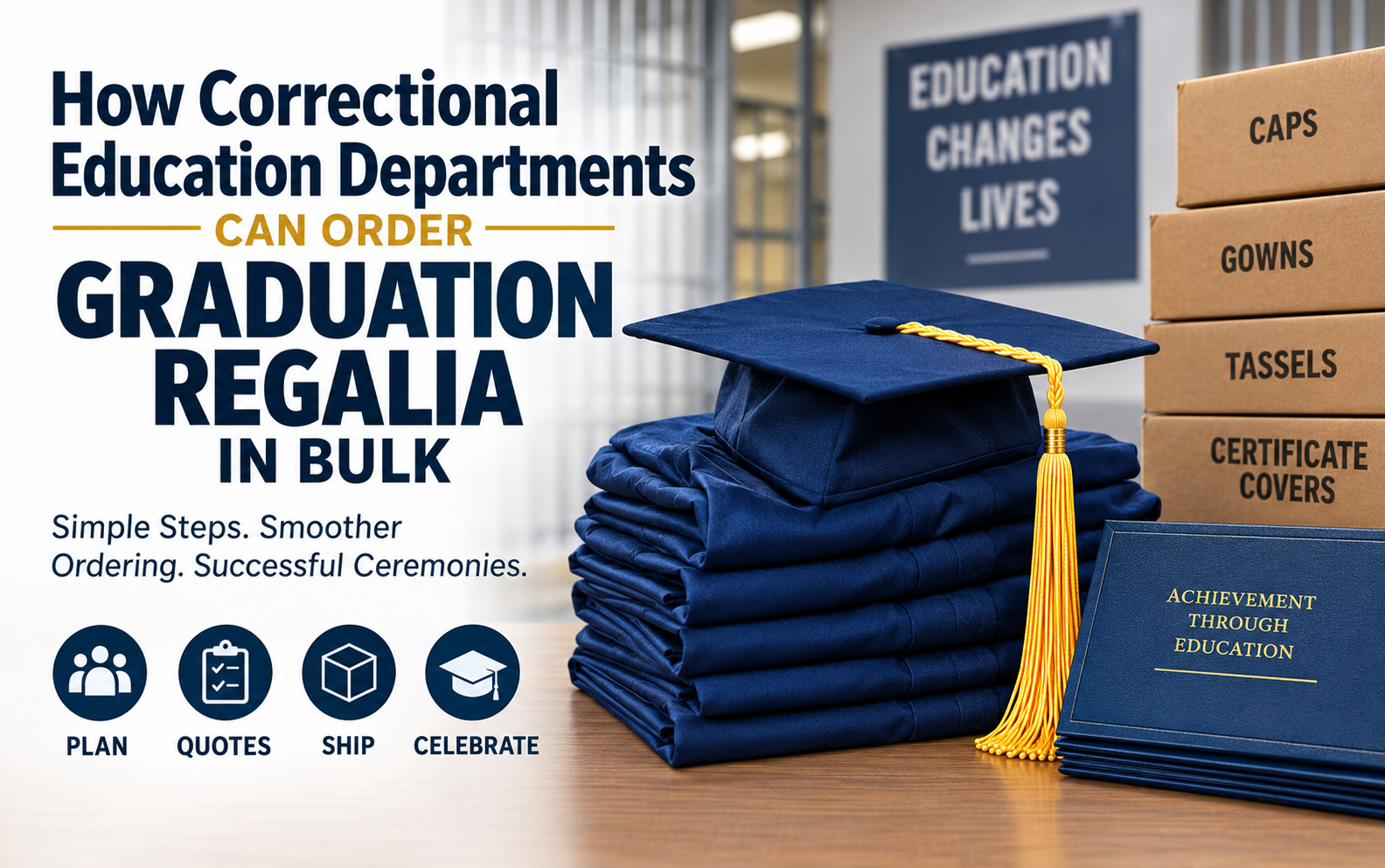
Correctional education departments planning graduation and educational achievement ceremonies often need more than a basic cap-and-gown order. Administrators may be coordinating several programs, multiple credential types, a wide range of participant sizes, institutional purchasing requirements, security reviews and delivery procedures at the same time.
A well-organized correctional education bulk bachelors graduation regalia order starts with the educational programs being recognized. GED or high school equivalency completion, vocational training, apprenticeships, workforce programs, certificates and college degrees may require different ceremony products.
Instead of ordering one identical package for every participant, correctional education departments can create a purchasing plan that identifies the correct products, quantities and specifications for each graduating group. This approach can reduce ordering errors, unnecessary merchandise and last-minute shortages.
What Can Correctional Education Departments Order in Bulk?
Depending on the ceremony and institutional requirements, a bulk graduation order may include:- Graduation gowns
- Mortarboard caps
- Graduation tassels
- Year charms
- Certificate covers
- Diploma covers
- Graduation stoles
- Honor cords
- Achievement cords
- Bachelor’s regalia
- Master’s regalia
- Doctoral regalia
- Academic hoods where degree-appropriate
Step 1: Identify Every Program Included in the Ceremony
Begin with a complete list of programs whose participants will be recognized.Programs Could Include:
- Adult basic education
- GED or high school equivalency
- Literacy programs
- Career and technical education
- Vocational training
- Occupational education
- Apprenticeships
- Workforce-development programs
- Employment-readiness training
- Industry credential programs
- Educational certificate programs
- College certificate programs
- Associate degree programs
- Bachelor’s degree programs
- Graduate degree programs
Step 2: Identify the Credential Each Group Is Receiving
The credential should determine the recognition package. A participant receiving a vocational certificate should not automatically receive the same academic regalia as someone earning a college degree.Create Credential Groups Such As:
- GED or high school equivalency
- Vocational completion
- Apprenticeship completion
- Workforce training
- Certificate achievement
- Associate degree
- Bachelor’s degree
- Master’s degree
- Doctoral degree
Step 3: Create a Graduation Package for Each Credential
Once the credential groups are established, determine what each group should receive.GED Graduation Package
- Standard graduation gown
- Mortarboard cap
- Tassel
- Certificate cover
Vocational or Career Training Package
- Standard graduation gown where appropriate
- Mortarboard cap where approved
- Tassel
- Certificate cover
- Approved stole or achievement cord where applicable
Certificate Recognition Package
- Certificate cover
- Optional standard gown
- Approved recognition accessory where appropriate
College Degree Package
- Degree-appropriate gown
- Required academic headwear
- Tassel
- Academic hood where required
- Diploma cover
Step 4: Verify College Regalia With the Degree-Granting Institution
College graduates require additional attention because academic apparel may be determined by the participating college or university. Correctional education departments should obtain the current specifications directly from the degree-granting institution.Verify:
- Degree level
- Gown style
- Gown color
- Headwear
- Tassel requirements
- Academic hood requirements
- Any institution-specific commencement specifications
Bachelor’s Academic Hoods Should Not Be Assumed
Bachelor’s hood practices vary by institution, and many institutions do not use academic hoods for bachelor’s graduates. Do not add hoods to a bulk bachelor’s order unless the degree-granting institution requires them.Step 5: Determine the Total Number of Participants
Establish a preliminary headcount for every credential group.For Example:
- GED graduates — 72
- Vocational completers — 48
- Apprenticeship completers — 16
- Certificate recipients — 27
- Associate degree graduates — 12
- Bachelor’s degree graduates — 8
Step 6: Calculate Quantities by Product
A more accurate bulk order calculates each product separately.Example Bulk Order:
- 136 standard graduation gowns
- 136 mortarboard caps
- 136 standard tassels
- 163 certificate covers
- 20 diploma covers
- 25 approved graduation stoles
- 18 achievement cords
- 12 associate-degree regalia sets
- 8 bachelor’s regalia sets
Step 7: Build the Graduation Gown Size Distribution
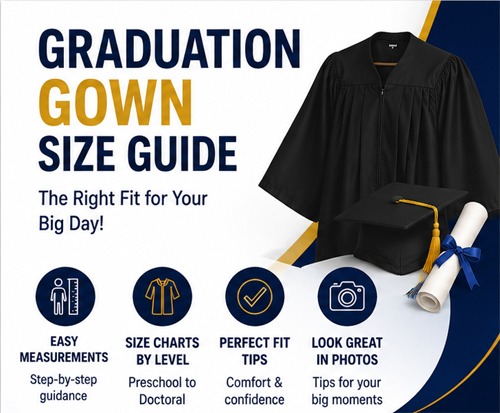
One of the most important parts of a bulk masters graduation cap and gown order is sizing. Do not simply send the supplier a total gown quantity. Provide quantities by the sizing categories used for the selected product.Example Size Distribution:
- Size range A — 14 gowns
- Size range B — 31 gowns
- Size range C — 39 gowns
- Size range D — 28 gowns
- Size range E — 17 gowns
- Extended sizes — 7 gowns
Use the Size Chart for the Actual Gown
Graduation gown sizing is not necessarily identical among manufacturers or product lines. Select the proposed gown first and use the current sizing chart for that particular product when building the final order.Identify Extended Sizes Early
Do not wait until the purchase order is ready to identify extended-size requirements. Availability can differ from standard sizes, so the supplier should evaluate the entire size distribution before the department finalizes its gown style and color.Protect Participant Privacy When Sending Size Information
A graduation supplier generally needs product specifications and quantities rather than correctional records or unrelated personal information. Where permitted by institutional procedures, departments can provide aggregate quantities by size instead of participant names or other unnecessary identifying information.Step 8: Select a Standard Graduation Gown
For GED, vocational and other non-degree recognition programs, a standard graduation gown can simplify a large institutional order.Compare Gowns Based On:
- Available colors
- Matte or shiny finish
- Fabric and construction
- Standard size availability
- Extended sizes
- Current inventory
- Whether caps are included
- Whether tassels are included
- Price at the required quantity
Step 9: Choose Matte or Shiny Gowns
Matte gowns provide a lower-sheen appearance, while shiny gowns have a more reflective finish. Either can be considered for correctional education ceremonies. Selection can be based on program preference, availability and budget. There is no universal requirement that correctional education graduates wear one particular gown finish.Step 10: Select the Gown Color
Programs can choose an available gown color that works with their ceremony plan.Consider:
- Existing education department traditions
- Program identity
- College partner requirements
- Inventory availability
- Availability across all required sizes
- Potential reuse
Step 11: Determine Cap Requirements
Mortarboards are commonly used with standard graduation gowns, but a correctional department should determine whether the proposed cap is permitted at the intended institution. Commercial availability should never be interpreted as facility approval.Step 12: Select Graduation Tassels
Determine whether the ceremony will use one standard tassel color or approved distinctions between programs.Confirm:
- Tassel color
- Total quantity
- Whether tassels are included with caps
- Whether year charms are required
- Whether multiple approved colors are needed
Be Conservative With Year-Specific Merchandise
Participant counts can change between the initial order and the ceremony. Dated tassels and year charms have less reuse value than undated products, so departments may want to align those quantities closely with the confirmed graduating population.Step 13: Select Certificate and Diploma Covers
Certificate covers can be especially useful for GED, vocational, apprenticeship and educational certificate programs. Diploma covers may be appropriate for college degrees or other credentials depending on the document being presented.Before Ordering Covers, Confirm:
- Document width
- Document height
- Portrait or landscape orientation
- Required cover dimensions
- Interior configuration
- Color
- Quantity
- Blank or customized design
Blank Covers Can Simplify Bulk Purchasing
Blank certificate covers may be useful when several education programs issue documents of compatible dimensions. They can also provide more flexibility for future ceremonies than year-specific or heavily customized merchandise.Step 14: Decide Whether Custom Covers Are Necessary
Customized certificate or diploma covers can potentially include authorized program names or artwork. However, customization may involve minimum quantities, additional production time, artwork requirements and additional costs. Correctional department logos, state seals, government marks, college trademarks and other protected branding should only be reproduced with appropriate authorization.Step 15: Determine Whether Stoles or Cords Are Needed
Graduation stoles and achievement cords can help identify approved distinctions, but they should have a defined purpose.Before Adding Them to the Order, Determine:
- What the accessory represents
- Who is eligible
- Required color
- Quantity
- Whether customization is required
- Whether the institution permits the product
Avoid Universal Claims About Cord Colors
There is no single universal cord-color system that applies to all correctional education, GED, vocational or workforce programs. The responsible organization should establish the meaning of its recognition colors.Step 16: Create a Master Bulk-Order Worksheet
A centralized worksheet can make a large institutional order easier to manage.Recommended Columns Include:
- Program
- Credential
- Product
- Color
- Finish
- Size
- Quantity
- Standard or extended size
- Customization
- Approval status
- Stocked or custom
- Required delivery date
Step 17: Separate Required Products From Optional Products
Separating core merchandise from optional recognition accessories makes budgeting easier.Core Products Could Include:
- Graduation gown
- Cap
- Tassel
- Certificate or diploma cover
Conditional Products Could Include:
- Graduation stole
- Achievement cord
- Honor cord
- Year charm
- Academic hood
- Custom cover
- Specialized doctoral apparel
Step 18: Review Products With Authorized Institutional Personnel
When graduation merchandise will enter or be used within a correctional institution, the responsible correctional organization should determine whether each proposed product satisfies applicable security, property, receiving and operational requirements. A supplier cannot make that determination on behalf of the institution.Review the Entire Package Component by Component
The Review May Include:
- Graduation gown
- Mortarboard
- Tassel
- Tassel charm
- Stole
- Cord
- Certificate cover
- Diploma cover
- Academic hood
- Custom decoration
- Packaging
Never Assume That a Product Is “Correctional Approved”
A commercially available graduation product should not be described as “correctional approved,” “DOC approved,” “prison approved,” “institution approved” or “facility compliant” unless the relevant authority has actually established that approval. Requirements can vary between jurisdictions and individual institutions.Step 19: Prepare a Detailed Request for Quote
A complete RFQ allows graduation suppliers to quote the same requirement and makes price comparisons more meaningful.A Bulk Graduation Regalia RFQ Should Include:
- Type of educational programs
- Credential groups
- Total quantities
- Gown style
- Gown color
- Matte or shiny finish
- Quantity by size
- Extended sizes
- Cap quantity
- Tassel specifications
- Certificate-cover dimensions
- Diploma-cover requirements
- Stoles
- Cords
- Academic hoods where applicable
- Custom products
- Approved artwork where applicable
- Requested delivery date
- Approved shipping destination
- Purchasing requirements
Step 20: Compare Equivalent Supplier Quotes
Do not evaluate suppliers using gown price alone. One quotation might include a cap and tassel while another lists them separately.Compare:
- Unit price
- What is included
- Extended-size pricing
- Certificate covers
- Accessories
- Customization
- Shipping
- Processing requirements
- Total delivered cost
Calculate the Delivered Cost Per Graduate
A useful institutional comparison is the total delivered cost divided by the number of participants receiving the applicable package. For a ceremony containing several credential groups, calculate the cost separately for each package.For Example:
- GED package cost per graduate
- Vocational package cost per participant
- Certificate-recognition cost per participant
- College regalia cost per graduate
Step 21: Ask About Institutional and Volume Pricing
Correctional education departments purchasing coordinated quantities can ask whether institutional or volume pricing is available. Pricing may depend on quantity, product type, gown size distribution, accessories, customization, inventory and shipping requirements.Step 22: Verify Inventory Before Issuing the Order
Bulk orders should be checked across the complete product list rather than confirming only the most common gown sizes.Verify Availability Of:
- Every standard gown size
- Extended sizes
- Selected gown color
- Mortarboards
- Tassels
- Year charms
- Certificate covers
- Diploma covers
- Stoles
- Cords
- Academic hoods
- Degree-specific gowns
- Custom merchandise
Step 23: Separate Stocked Products From Custom Products
Standard stocked graduation merchandise and custom-made products can have very different fulfillment timelines.Potentially Stocked Merchandise May Include:
- Standard gowns
- Mortarboards
- Standard tassels
- Some cords
- Some certificate covers
Products That May Require Additional Lead Time Include:
- Custom stoles
- Decorated certificate covers
- Special academic hoods
- Custom doctoral regalia
- Other customized products
Step 24: Understand the Complete Order Timeline
Shipping time is only one part of institutional fulfillment.A Bulk Order Can Involve:
- Program completion confirmation
- Participant headcount
- Size collection
- Product selection
- Institutional review
- RFQ preparation
- Quote evaluation
- Procurement approval
- Artwork approval
- Custom production
- Supplier processing
- Carrier transportation
- Institutional receiving
- Inspection
- Internal distribution
Step 25: Do Not Rely on Expedited Shipping as the Main Plan
Expedited shipping may reduce carrier transit time for qualifying stocked merchandise. It cannot eliminate institutional approval, procurement, artwork approval, production or internal receiving time.Step 26: Confirm the Exact Delivery Destination
Do not assume that a correctional institution’s publicly listed address is the correct receiving address for a commercial shipment.Confirm With the Purchaser:
- Legal organization name
- Facility or institution
- Education department
- Approved receiving address
- Attention line
- Purchase order or reference number
- Package-labeling requirements
- Receiving instructions
- Carrier restrictions where applicable
Step 27: Plan for Multiple Facilities When Necessary
A state correctional education department or other large system may purchase graduation supplies for several institutions. Before requesting pricing, determine whether the supplier should:- Ship the entire order to one central warehouse
- Ship to the education department
- Create separate shipments for individual institutions
- Package merchandise by program
- Package merchandise by facility
Step 28: Consider Centralized Bulk Purchasing
Where procurement policies permit it, a correctional education system serving multiple facilities can evaluate whether standardized products and consolidated purchasing are practical.Potential Advantages Can Include:
- Consistent product specifications
- More organized purchasing
- Simplified future reorders
- Potential volume pricing
- Consistent ceremony appearance
- Reduced duplication of product evaluation
Step 29: Separate Merchandise by Facility or Program
A large shipment containing hundreds of gowns can create unnecessary work if everything arrives mixed together. Ask whether products can be organized or labeled according to the purchaser’s approved fulfillment plan.Possible Divisions Include:
- Facility
- Education program
- Credential
- Gown size
- Product category
Step 30: Build a Small Contingency Plan
Graduating populations can change because of eligibility, program completion, transfers or other circumstances. Where permitted by budget and policy, administrators can consider whether a limited quantity of flexible, reusable standard merchandise is appropriate for last-minute sizing or participant changes. A contingency quantity should be based on the program’s experience rather than an arbitrary percentage.Prioritize Reusable Products for Contingency Inventory
Undated standard gowns, compatible mortarboards and blank certificate covers may offer greater future flexibility than customized or year-specific products. Departments should also review applicable inventory, property and reuse policies before purchasing extra merchandise.Step 31: Determine the Government Purchasing Method
If the correctional education department is purchasing with public funds, applicable procurement procedures may govern the transaction. Requirements can vary by federal, state or local jurisdiction, purchasing threshold, funding source and agency policy. The responsible procurement office should determine the correct purchasing method.Formal Institutional Quotes
A commercial graduation supplier may be able to prepare a formal quotation containing:- Supplier information
- Product descriptions
- Quantities
- Unit prices
- Extended totals
- Shipping
- Applicable transaction terms
Purchase Orders
Some government and institutional buyers use purchase orders. Before issuing a PO, verify whether the supplier currently accepts purchase orders for the proposed transaction and confirm applicable credit, payment and purchasing terms.Vendor Registration
Some government entities require a supplier to complete registration or provide documentation before receiving an order. Procurement personnel should verify requirements through the applicable official purchasing system.Competitive Purchasing and Bid Requirements
Depending on the jurisdiction and purchase amount, competitive quotations, bidding, cooperative purchasing or another procurement method may apply. The responsible government procurement office—not the graduation supplier—should determine the applicable process.Never Assume Approved-Vendor or Contract Status
A company offering products to correctional education departments should not be represented as a government contract holder, approved vendor, preferred supplier or awarded contractor unless that status has actually been established.Step 32: Review the Supplier Before Purchasing
Bulk institutional orders can involve significant quantities and firm ceremony deadlines.Evaluate Whether the Supplier Can Provide:
- The required gown style
- The complete size range
- Extended sizes
- Required colors
- Caps and tassels
- Certificate and diploma covers
- Stoles and cords
- Degree-specific academic regalia
- Product specifications
- Formal quotes
- Institutional quantities
- Clear processing information
- Shipping options
- Responsive institutional support
Bulk Correctional Education Graduation Order Checklist
- List every participating education program
- Identify the credential for each group
- Create the appropriate recognition package
- Obtain college specifications where applicable
- Confirm preliminary participant counts
- Calculate quantities by individual product
- Select gown style
- Select gown color
- Select matte or shiny finish
- Build quantities by gown size
- Identify extended sizes
- Confirm cap requirements
- Select tassels
- Determine year-specific accessories
- Measure certificates and diplomas
- Select certificate and diploma covers
- Determine whether stoles or cords are needed
- Identify custom products
- Prepare the master order worksheet
- Separate required and optional products
- Complete institutional product review
- Prepare a detailed RFQ
- Compare equivalent supplier packages
- Calculate delivered cost per graduate
- Ask about institutional pricing
- Verify complete inventory
- Separate stocked and custom merchandise
- Establish the procurement timeline
- Confirm exact delivery location
- Determine whether multiple destinations are required
- Determine the authorized purchasing method
- Confirm payment and PO requirements
- Place the order with sufficient lead time
- Inspect merchandise after receipt
Questions to Ask a Bulk Graduation Regalia Supplier
- Can you supply the complete required quantity?
- Which gown styles are available?
- Which colors are available in the required quantities?
- What size chart applies to the selected gown?
- Are extended sizes available?
- Can individual replacement gowns be ordered?
- Are caps included?
- Are tassels included?
- Which tassel colors are available?
- Are certificate covers available?
- Which cover dimensions are available?
- Are blank diploma covers available?
- Are graduation stoles available?
- Are achievement and honor cords available?
- Can bachelor’s, master’s and doctoral regalia be supplied?
- Can academic hoods be supplied to institutional specifications?
- Can authorized custom products be produced?
- What custom minimums apply?
- Can product specifications be provided for institutional review?
- Can a formal institutional quote be prepared?
- Is volume or institutional pricing available?
- Which products are currently stocked?
- Which products require production?
- What processing time applies?
- Can orders be separated by facility or program?
- Can multiple approved destinations be supported?
- What shipping methods are available?
- Are expedited options available for qualifying stocked merchandise?
- Are purchase orders accepted for qualifying transactions?
Cap and Gown Outlet for Bulk Correctional Education Orders
Cap and Gown Outlet is an independent commercial graduation apparel supplier that can be evaluated by correctional education departments, government organizations, schools, colleges, workforce programs and other institutional purchasers seeking graduation and educational recognition merchandise. Available product categories can include bachelors graduation gowns, mortarboard caps, tassels, certificate covers, diploma covers, graduation stoles, honor cords, achievement cords, bachelor’s regalia, master’s regalia, doctoral regalia and academic hoods where degree-appropriate.Potential Institutional Ordering Capabilities
- Individual graduation products
- Small-group orders
- Bulk graduation regalia orders
- No minimum quantity where applicable
- Multiple gown sizes
- Extended sizes where available
- Multiple gown colors
- Matte and shiny gowns where available
- Mortarboard caps
- Graduation tassels
- Certificate covers
- Diploma covers
- Graduation stoles
- Honor and achievement cords
- Degree-specific academic regalia where appropriate
- Formal institutional quotations
- Institutional or volume pricing
- Nationwide U.S. shipping
- Fast processing for qualifying stocked merchandise
- Expedited shipping options where available