Planning a school graduation ceremony involves hundreds of decisions, but few are as visible as the graduation gowns worn by students. Whether a school is celebrating kindergarten graduates, recognizing eighth-grade achievement, or organizing a large high school commencement, coordinated academic apparel helps create a professional and memorable ceremony.
Choosing the right graduation gowns for pre-schools involves more than selecting a color and placing an order. Administrators and graduation committees must consider gown styles, fabrics, student measurements, size availability, accessories, budgets, supplier capabilities, and delivery schedules.
A school may need 30 gowns for a preschool ceremony, 150 sets for an eighth-grade promotion, or 500 graduation outfits for a high school commencement. Each situation requires a different approach to purchasing and inventory planning.
This guide explains how schools can choose suitable graduation gown styles, coordinate colors, collect accurate measurements, estimate quantities, compare purchasing options, and prepare for an organized graduation day.
Why Choosing the Right Graduation Gowns Matters for Schools
Graduation apparel contributes to the overall appearance and organization of a commencement ceremony. When students wear coordinated gowns, the ceremony presents a consistent visual identity and gives graduates a shared sense of occasion.
However, appearance is only one consideration. The apparel must also be practical for the students who will wear it.
Five Important School Graduation Gown Priorities
- Appropriate style: The gown should match the academic level and school requirements.
- Consistent color: Apparel should follow the school’s approved color scheme.
- Correct sizing: Students should be able to walk, sit, stand, and participate comfortably.
- Accurate quantities: Schools need sufficient gowns and accessories for participating graduates.
- Reliable planning: Purchasing and delivery schedules should allow time for inspection and distribution.
Successful graduation apparel planning balances these priorities with the school’s available budget.
1. Choose Graduation Gown Styles Based on School Level
The first step is determining which graduation gown style is appropriate for the students and ceremony.
Graduation gowns are not identical across all educational levels. Differences may include sleeve construction, garment length, fabric, closures, and decorative details.
Preschool and Kindergarten Graduation Gowns
Preschool and kindergarten ceremonies often use simple, child-sized graduation gowns paired with coordinating caps and tassels.
For young children, schools should prioritize comfortable construction, appropriate garment length, and age-suitable headwear.
Some programs use bright colors, while others select colors associated with the school.
Elementary School Graduation Gowns
Elementary school recognition ceremonies may use graduation gowns to celebrate completion of a grade or transition to middle school.
Schools should select youth-sized products and confirm that gown lengths are appropriate for the students.
Middle School Graduation Gowns
Middle school promotion ceremonies often involve students with a wide range of heights and body proportions.
Schools should review the available youth and adult sizing ranges rather than assuming that one size category will accommodate every student.
High School Graduation Gowns
High school commencement commonly involves coordinated graduation gowns, caps, and tassels.
Schools may require particular colors, finishes, or garment styles. Some institutions also use different approved colors for different student groups.
The school’s official academic dress policy should determine the final selection.
Community College and University Graduation Gowns
Colleges and universities may use different gown designs for associate, bachelor’s, master’s, and doctoral graduates.
Academic hoods, sleeve construction, and distinctive institutional designs may also affect purchasing requirements.
Universities should confirm degree-level and institution-specific specifications before placing group orders.
2. Understand the Different Graduation Gown Styles
Graduation gowns are available in different constructions, and schools should compare the specific products being considered.
Traditional Graduation Gowns
Traditional graduation gowns are designed to provide a formal ceremonial appearance. Their details vary according to academic level and manufacturer.
Front-Zipper Graduation Gowns
Many school graduation gowns use front zippers, which can make dressing and removal straightforward.
Schools should verify the closure design when comparing products.
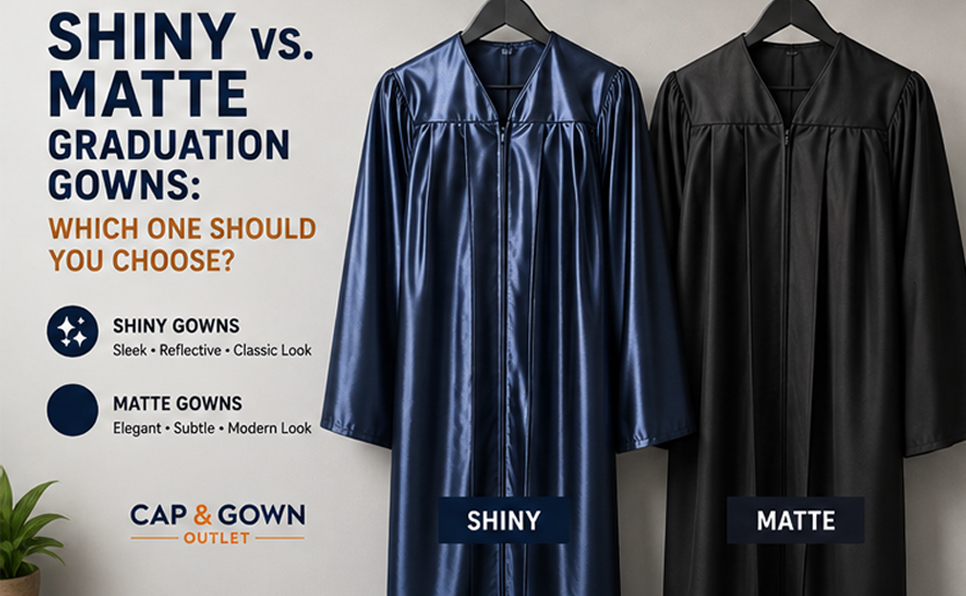
Matte Graduation Gowns
Matte gowns generally have a less reflective finish. Schools may prefer this appearance for formal ceremonies and photography.
Shiny Graduation Gowns
Shiny gowns have a more reflective finish and may be selected for particular school traditions or visual preferences.
Specialized Academic Gowns
Master’s and doctoral gowns may have distinctive sleeve and decorative features. Some institutions require designs that cannot be replaced with standard school gowns.
Graduation Gown Style Comparison
| Gown Type | Common Application | Important Consideration |
|---|---|---|
| Child-Sized Gown | Preschool and Kindergarten | Age-appropriate sizing and construction |
| Youth Graduation Gown | Elementary and Middle School | Height range and comfortable fit |
| Standard School Gown | High School | Approved color, style, and fabric |
| Bachelor’s Gown | Undergraduate Commencement | Institutional academic dress requirements |
| Master’s Gown | Graduate Commencement | Correct sleeve design and related regalia |
| Doctoral Gown | Doctoral Commencement | Specialized or institution-specific details |
3. How to Choose Graduation Gown Colors for Schools
Color selection is one of the most visible decisions in graduation apparel planning.
Some schools have established graduation gown colors that are used every year. Others have flexibility when planning preschool, kindergarten, elementary, or recognition ceremonies.
Popular Graduation Gown Colors
- Black
- Navy blue
- Royal blue
- Red
- Maroon
- White
- Green
- Gold
- Purple
Color availability depends on the product and supplier.
Match Graduation Gowns to School Colors
Many schools choose gowns that complement their official colors.
For example, a school using navy blue and gold may choose navy gowns with approved gold tassels.
A school with red and white branding may select an appropriate red or white gown, depending on tradition and availability.
These are illustrative design possibilities, not universal graduation color rules.
Consider Photography and Ceremony Appearance
Schools should consider how the selected gown colors will appear in group photographs and against the ceremony backdrop.
Color consistency may be especially important when students purchase apparel through different channels.
Check Exact Color Specifications
Color names such as royal blue, navy, or maroon can vary among manufacturers.
Where matching is important, schools should review actual product specifications or samples rather than relying exclusively on screen photographs.
4. Matte vs. Shiny Graduation Gowns: Which Is Better for Schools?
Schools frequently compare matte and shiny graduation gowns.
Neither finish is universally superior. The right choice depends on school traditions, desired appearance, product quality, and budget.
| Feature | Matte Gowns | Shiny Gowns |
|---|---|---|
| Appearance | Less reflective | More reflective |
| Photography | Generally produces fewer strong reflections | May create visible highlights |
| Fabric Feel | Varies by product | Varies by product |
| Durability | Depends on construction | Depends on construction |
| Cost | Varies by supplier | Varies by supplier |
| Best Choice | When required or preferred | When required or preferred |
Schools should evaluate actual samples or product specifications when possible.
5. Select Graduation Gown Fabrics for Comfort and Appearance
Fabric selection influences how a graduation gown looks, drapes, and feels during the ceremony.
Graduation apparel is often made using polyester or other synthetic and blended fabrics, but material characteristics vary.
Important Fabric Considerations
- Fabric weight
- Breathability and comfort
- Drape and appearance
- Resistance to visible wrinkling
- Ease of care
- Stitching and construction
- Expected reuse
Outdoor summer ceremonies may call for different comfort considerations than indoor winter events.
Heavier fabric is not automatically better quality, and lightweight fabric is not necessarily unsuitable.
Schools should select fabric based on the actual product and ceremony requirements.
6. How to Measure Students for Graduation Gowns
Correct sizing is essential when ordering graduation gowns for an entire school.
Academic gown sizes may be determined using height, with additional measurements requested for certain products.
Schools should obtain the exact manufacturer’s sizing chart before collecting student information.
Measure Student Height
- Have the student stand upright against a wall.
- Remove shoes unless the manufacturer’s instructions say otherwise.
- Measure from the floor to the top of the head.
- Record the measurement accurately.
- Use the selected product’s sizing chart to determine the gown size.
Collect Additional Measurements When Required
Some products request weight, chest or bust measurements, or additional-fit information.
Do not assume every manufacturer uses the same sizing method.
Account for Different Body Proportions
Students of the same height may require different gown fits.
Schools should review fuller-cut or additional-fit options when available rather than choosing an unnecessarily longer gown to gain body width.
Measure Graduation Caps When Necessary
Some graduation caps are adjustable or designed for a range of head sizes, while others require specific measurements.
Follow the selected cap’s sizing instructions.
7. Create a School Graduation Gown Size Chart
After selecting a gown product, schools can create a student-friendly sizing worksheet based on the manufacturer’s official chart.
Because size systems vary, schools should not publish a universal size chart that may not match the selected product.
Sample Student Measurement Worksheet
| Student ID | Height | Additional Fit Information | Supplier Gown Size |
|---|---|---|---|
| 001 | 4 ft 8 in | As required | Based on supplier chart |
| 002 | 5 ft 1 in | As required | Based on supplier chart |
| 003 | 5 ft 6 in | As required | Based on supplier chart |
| 004 | 5 ft 11 in | As required | Based on supplier chart |
Collect only the personal information necessary for sizing and protect student records according to applicable privacy requirements.
8. How to Calculate Graduation Gown Quantities for Schools
Determining the correct quantity is one of the most important parts of school graduation apparel planning.
Ordering too few gowns can create shortages. Ordering too many may leave unused inventory and increase costs.
The starting point is the number of students who actually need school-provided graduation apparel.
Basic Graduation Gown Quantity Formula
Required gown quantity = confirmed graduates needing gowns + approved spare gowns.
Before calculating the final quantity, subtract students who already have acceptable school-approved apparel or who are purchasing through a separate approved arrangement.
Example: School With 250 Graduates
| Planning Item | Quantity |
|---|---|
| Confirmed Graduates | 250 |
| Students With Approved Existing Gowns | 15 |
| Students Purchasing Separately | 10 |
| Students Requiring School-Provided Gowns | 225 |
| Approved Spare Gowns | 5 |
| Total School Order | 230 |
These numbers are hypothetical and demonstrate the calculation process.
The appropriate number of spare gowns depends on historical needs, student participation uncertainty, budget, and supplier policies.
9. Determine Graduation Gown Quantities by Size
After calculating the total number of gowns, schools must divide the order by size.
This is where accurate student measurements become especially valuable.
Sample School Graduation Gown Order
| Supplier Size | Quantity | Color |
|---|---|---|
| Size A | 25 | Navy Blue |
| Size B | 45 | Navy Blue |
| Size C | 70 | Navy Blue |
| Size D | 55 | Navy Blue |
| Size E | 35 | Navy Blue |
| Total | 230 |
The size labels and quantities are illustrative. Use the actual supplier’s size chart and verified student measurements.
If a school uses multiple gown colors, create a separate size breakdown for each color.
10. Decide Whether to Order Graduation Caps and Gowns as Complete Sets
Some schools purchase complete graduation cap and gown sets, while others order gowns and accessories separately.
A complete package may simplify purchasing and distribution when it includes every required item.
Common Graduation Package Components
- Graduation gown
- Graduation cap
- Tassel
- Academic hood, when required
- Approved graduation stole
- Honor cords, when applicable
- Diploma or certificate cover
Package contents vary by supplier.
Schools should compare the complete cost of all required products rather than assuming a bundle is always cheaper.
11. How Many Graduation Caps and Tassels Should Schools Order?
Schools should determine cap and tassel quantities separately from gown quantities when the products are not sold as complete sets.
Not every student necessarily requires a new cap or tassel.
For example, students may already have approved items or may need replacements only.
Accessory Quantity Checklist
- Number of graduates needing caps
- Number of graduates needing tassels
- Approved tassel colors
- Any institution-required specialty tassels
- Replacement accessory requirements
- Available school-owned inventory
Academic hoods and recognition accessories should be counted separately where applicable.
12. Compare Bulk Graduation Gown Pricing for Schools
Schools should evaluate the total cost of graduation apparel before selecting a supplier.
Some suppliers may offer quantity-based pricing, but discounts depend on actual supplier terms.
Factors Affecting Graduation Gown Costs
- Gown style
- Academic level
- Fabric and finish
- Quantity
- Color availability
- Accessories
- Customization
- Shipping
- Required delivery timeline
Sample Graduation Apparel Budget
| Expense | Illustrative Cost |
|---|---|
| 230 Graduation Gowns at $18 | $4,140 |
| 230 Caps and Tassels at $5 | $1,150 |
| Shipping | $210 |
| Total Before Applicable Taxes | $5,500 |
These prices are hypothetical examples, not current supplier quotations.
In this illustration, the average cost is approximately $23.91 per graduation package, including the planned spare inventory in the total cost.
Actual costs should be calculated using current supplier quotations.
13. Choose Between School-Funded and Student-Paid Graduation Apparel
Schools may use different purchasing arrangements depending on their budgets and policies.
School-Funded Orders
The school purchases graduation apparel and distributes it to students.
Student-Paid Orders
Students or families purchase approved apparel individually or through a school-coordinated arrangement.
School-Coordinated Group Orders
The school collects sizes and coordinates purchasing, while payment responsibilities are established separately.
Whichever arrangement is selected, schools should clearly communicate approved products, payment procedures, deadlines, and distribution expectations.
14. Consider Reusable Graduation Gowns for Schools
Some schools purchase graduation gowns that can be collected, cleaned, stored, and reused in future years.
Reusable apparel may reduce future purchasing needs, but it also creates maintenance and administrative responsibilities.
Factors to Evaluate
- Initial purchasing cost
- Fabric durability
- Cleaning requirements
- Storage space
- Annual size distribution
- Replacement needs
- Staff time for collection and redistribution
Schools should compare the long-term costs of reusable inventory with annual purchasing costs before selecting a strategy.
15. When Should Schools Order Graduation Gowns?
Schools should begin planning early enough to complete purchasing approvals, collect student sizes, obtain supplier quotations, and receive the apparel before distribution.
For many schoolwide orders, beginning the process three to six months before commencement is a useful planning approach.
Custom gowns or large institutional orders may require additional lead time.
Sample School Graduation Apparel Timeline
| Time Before Ceremony | Recommended Activity |
|---|---|
| 5–6 Months | Establish budget, confirm gown styles and colors |
| 4 Months | Collect student measurements and research suppliers |
| 3 Months | Request quotations and obtain purchasing approvals |
| 2 Months | Finalize orders where supplier lead times permit |
| 3–6 Weeks | Receive and inspect shipments as scheduled |
| 1–3 Weeks | Distribute gowns and resolve sizing problems |
| Graduation Week | Confirm outstanding apparel requirements |
These are illustrative planning periods. Actual deadlines should be based on confirmed supplier estimates and institutional purchasing requirements.
16. How to Request Graduation Gown Quotes From Suppliers
When contacting graduation apparel suppliers, schools should provide enough information to receive accurate pricing.
School Graduation Gown Quote Checklist
- School or organization name
- Purchasing contact
- Academic level
- Required gown style
- Gown color
- Matte or shiny finish, if specified
- Total quantity
- Quantity by size
- Cap and tassel requirements
- Other required accessories
- Customization details
- Delivery location
- Required delivery date
- Purchasing documentation requirements
Suppliers can provide more meaningful quotations when product specifications and quantities are clear.
17. Evaluate School Graduation Gown Suppliers
Price should not be the only factor in selecting a graduation apparel supplier.
Schools should evaluate whether a supplier can provide compatible products and communicate realistic fulfillment expectations.
Supplier Comparison Checklist
| Evaluation Factor | What to Verify |
|---|---|
| Gown Styles | Products match the academic level |
| Color Availability | Required colors are available |
| Size Range | All necessary student sizes can be accommodated |
| Fabric Quality | Construction and materials meet expectations |
| Pricing | Complete itemized quotation |
| Accessories | Required items are included or available |
| Delivery | Fulfillment estimates support the ceremony schedule |
| Purchasing Terms | Payment and documentation requirements are clear |
| Returns and Exchanges | Policies are understood before ordering |
18. How to Inspect Graduation Gowns After Delivery
When a bulk graduation apparel shipment arrives, schools should inspect it promptly.
Waiting until graduation week can leave insufficient time to resolve shortages or incorrect items.
School Receiving Checklist
- Count all cartons.
- Compare quantities with the purchase order.
- Verify gown colors.
- Check gown styles.
- Count quantities by size.
- Verify caps and tassels.
- Check required accessories.
- Inspect representative products for visible defects.
- Document missing or incorrect items.
- Contact the supplier promptly when necessary.
Schools should retain relevant purchasing and shipping documentation until the order has been reconciled.
19. Organize Graduation Gown Distribution to Students
Schools should establish a distribution process before students arrive to collect their graduation apparel.
Products can be organized by size, student identifier, homeroom, or academic program, depending on the institution’s needs.
Sample Distribution Record
| Student ID | Assigned Size | Package Received | Pickup Status |
|---|---|---|---|
| 001 | Size B | Cap, Gown, Tassel | Completed |
| 002 | Size C | Cap, Gown, Tassel | Pending |
| 003 | Size D | Cap, Gown, Tassel | Completed |
Students should be encouraged to try on their graduation apparel after receiving it.
Schools should establish a procedure for reporting missing items or sizing concerns.
20. Common Mistakes Schools Make When Ordering Graduation Gowns
Mistake 1: Choosing Colors Without Confirming School Requirements
Inconsistent colors may create problems during commencement.
Mistake 2: Selecting the Wrong Academic Gown Style
Different academic levels may require different gown designs.
Mistake 3: Using Ordinary Clothing Sizes
Graduation gowns may follow manufacturer-specific sizing systems.
Mistake 4: Estimating Quantities Without Confirmed Participation
Unverified counts can create shortages or excess inventory.
Mistake 5: Forgetting Caps and Tassels
Some gown listings do not include these accessories.
Mistake 6: Comparing Only Unit Prices
Shipping and accessories may affect total purchasing costs.
Mistake 7: Ordering Too Close to Graduation
Late ordering can reduce fulfillment flexibility.
Mistake 8: Ignoring Additional-Fit Requirements
Some students may need options beyond standard height-based sizing.
Mistake 9: Failing to Inspect Shipments
Missing or incorrect products may remain unnoticed until distribution.
Mistake 10: Not Tracking Student Pickup
Incomplete distribution records make it difficult to identify outstanding apparel.
Graduation Gowns for Public Schools and School Districts
Public schools and school districts may purchase graduation apparel through approved institutional purchasing procedures.
Purchasing departments should verify applicable quotation requirements, budget approvals, supplier documentation, and payment arrangements.
Some institutions may use purchase orders, while others use different authorized purchasing methods.
Supplier acceptance of purchase orders must be confirmed before ordering.
Graduation Gowns for Private and Charter Schools
Private and charter schools may have distinct traditions, colors, and graduation apparel requirements.
Administrators should establish written product specifications before comparing suppliers.
Where customization is desired, schools should verify artwork authorization, production requirements, and delivery estimates.
Graduation Gowns for Vocational Schools and Adult Education Programs
Vocational schools, trade schools, workforce training organizations, and adult education programs may organize ceremonies recognizing educational or career-training achievements.
Purchasing teams should select appropriate ceremonial apparel based on their program requirements.
Publicly funded programs should also confirm that graduation apparel purchases comply with applicable procurement and funding rules.
School Graduation Caps, Gowns and Bulk Apparel From Cap and Gown Outlet
Cap and Gown Outlet is an independent graduation apparel supplier and New Jersey-certified small business serving individual graduates, families, schools, colleges, universities, and educational organizations.
Depending on current product availability, graduation apparel categories may include:
- Preschool graduation caps and gowns
- Kindergarten graduation apparel
- Elementary school graduation gowns
- Middle school graduation gowns
- High school graduation cap and gown sets
- Associate degree graduation apparel
- Bachelor’s graduation gowns
- Master’s graduation regalia
- Doctoral graduation regalia
- Faculty academic regalia
- Academic hoods
- Graduation caps and tassels
- Graduation stoles and sashes
- Honor cords
- Diploma and certificate covers
- Bulk graduation apparel
Schools planning graduation apparel purchases can prepare a detailed request containing the required gown styles, colors, sizes, quantities, accessories, and delivery deadline.
Buyers should verify current product availability, applicable quantity pricing, customization options, fulfillment estimates, shipping arrangements, and purchasing terms before placing an order.
Institutional pricing and purchase order acceptance depend on current supplier policies.
Independent Supplier Disclosure
Cap and Gown Outlet is an independent graduation apparel supplier and is not affiliated with, sponsored by, endorsed by, or officially authorized by any school, college, university, educational organization, or government agency unless an actual relationship exists.
Frequently Asked Questions About Graduation Gowns for Schools
How do schools choose graduation gowns?
Schools should consider academic level, official gown requirements, colors, fabric, sizing, package contents, budget, and delivery timing.
What graduation gown colors are available for schools?
Common options may include black, navy, royal blue, red, maroon, white, green, gold, and purple. Actual availability depends on the product and supplier.
Are matte or shiny graduation gowns better for schools?
Neither is universally better. Schools should choose the finish that meets their requirements and desired appearance.
How should schools measure students for graduation gowns?
Use the selected manufacturer’s size chart and collect the measurements required for that product.
How many graduation gowns should a school order?
Calculate the number of participating students who need school-provided gowns, then add any approved spare inventory.
Should schools order extra graduation gowns?
Some spare inventory may be useful, but the appropriate amount depends on actual needs, budget, and supplier terms.
Do graduation gowns come with caps and tassels?
Some packages include them, while others do not. Confirm the product description before ordering.
Can schools order graduation gowns in bulk?
Yes, schools may purchase graduation apparel in group quantities from suppliers that support the required products and order sizes.
Are bulk graduation gowns cheaper?
Some suppliers may offer quantity-based pricing. Schools should compare actual quotations and total delivered costs.
How early should schools order graduation gowns?
Beginning planning three to six months before commencement can be useful. Actual deadlines depend on supplier lead times and school purchasing procedures.
Can schools order customized graduation gowns?
Customization may be available for certain products. Schools should verify artwork requirements, production time, pricing, and applicable policies.
Can elementary schools use graduation gowns?
Yes. Some elementary schools use gowns for promotion or recognition ceremonies.
What graduation gowns are appropriate for middle schools?
Schools should select an approved ceremonial style and use accurate youth or adult sizing as appropriate.
Can universities order different gown styles for different degrees?
Yes. Universities may require separate apparel specifications for associate, bachelor’s, master’s, and doctoral graduates.
Can public schools purchase graduation gowns using purchase orders?
Some suppliers may accept purchase orders. Schools should confirm supplier terms and follow their purchasing procedures.
How can schools avoid graduation gown shortages?
Confirm participation, collect accurate sizes, prepare a verified quantity summary, and inspect shipments promptly.
Are reusable graduation gowns a good option for schools?
They may be appropriate for some schools, but the total costs of cleaning, storage, replacement, and administration should be considered.
How should schools distribute graduation gowns?
Organize products by size or student assignment, track pickup, and establish a process for resolving missing or incorrect items.
Final School Graduation Gown Selection Checklist
- Confirm the ceremony date.
- Identify the graduation apparel coordinator.
- Establish the purchasing budget.
- Confirm school graduation gown requirements.
- Select the appropriate gown style.
- Choose the approved gown colors.
- Decide between matte and shiny finishes.
- Review fabric and construction details.
- Obtain the manufacturer’s size chart.
- Collect accurate student measurements.
- Review additional-fit options.
- Confirm the number of participating graduates.
- Identify students requiring school-provided gowns.
- Determine appropriate spare inventory.
- Prepare a quantity-by-size summary.
- Confirm cap and tassel requirements.
- Identify other required accessories.
- Request detailed supplier quotations.
- Compare total delivered costs.
- Verify customization requirements.
- Obtain purchasing approvals.
- Confirm supplier fulfillment estimates.
- Schedule delivery before distribution.
- Inspect shipments promptly.
- Organize inventory by size and product.
- Track student pickup.
- Resolve outstanding issues before commencement.
Choose the Right Graduation Gowns for a Successful School Ceremony
Selecting graduation gowns for pre-schools requires thoughtful planning and attention to detail.
By choosing appropriate gown styles, coordinating colors, collecting accurate student measurements, and calculating quantities carefully, schools can reduce ordering errors and create a more organized commencement experience.
Whether the ceremony involves a small kindergarten class, a middle school promotion, a high school graduating class, or a university commencement, clear product specifications and reliable purchasing procedures can help ensure students receive suitable academic apparel.
Plan early, select the right styles and sizes, verify your quantities, and help every graduate celebrate their achievement with confidence.