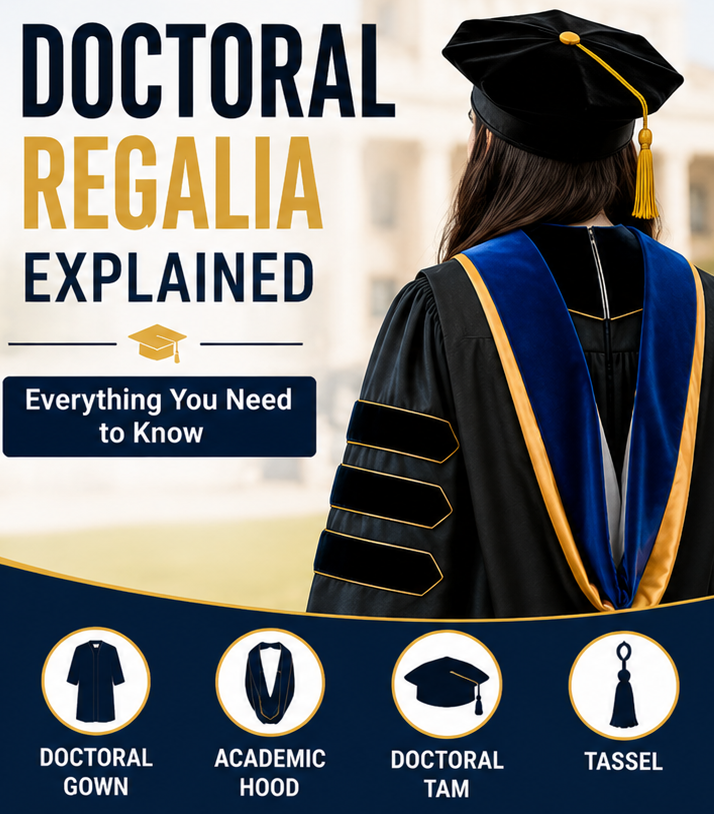
Faculty members are an important part of commencement ceremonies. Professors may process with graduates, sit with academic departments, present awards, participate in doctoral hooding or represent their college or university during formal academic events.
Choosing what to wear, however, can be confusing.
Should a professor wear a master’s gown or doctoral gown? Should the academic hood represent the university where the professor currently teaches or the institution where the degree was earned? Is a doctoral tam required? Can faculty wear their original graduation regalia?
The answers depend on the academic credential being represented, the degree-granting institution and the requirements or traditions of the institution hosting the ceremony.
This guide explains how to choose academic regalia for faculty commencement ceremonies and provides a practical process for selecting the gown, hood, headwear and accessories needed for commencement.
Start With the Host Institution’s Commencement Instructions
Before buying or renting faculty regalia, check the instructions provided by the college or university hosting the ceremony.
Institutions may establish their own expectations concerning:
- Required academic dress
- Faculty rental procedures
- Personally owned regalia
- Custom institutional gowns
- Academic headwear
- Faculty procession procedures
- Doctoral hooding responsibilities
- Authorized ceremonial accessories
Institutional requirements should take priority over general academic-regalia advice.
Step 1: Identify the Academic Degree You Are Representing
One of the most common mistakes is choosing regalia according to faculty title rather than academic credential.
Academic titles can include:
- Professor
- Associate Professor
- Assistant Professor
- Lecturer
- Instructor
- Department Chair
- Program Director
- Dean
These titles do not automatically determine the degree level of academic dress.
Instead, identify the earned academic degree you will represent during the ceremony.
Faculty Title and Degree Level Are Different
A professor does not automatically wear doctoral regalia simply because the individual is a faculty member.
Depending on the credential being represented, faculty academic dress may be:
- Bachelor’s-level regalia
- Master’s-level regalia
- Doctoral-level regalia
- Institution-specific academic dress
Faculty role describes who you are at the institution. Degree level helps determine the academic dress you may wear.
Step 2: Determine the Correct Gown Level
Once the represented degree is established, identify the appropriate gown.
Bachelor’s Faculty Gown
A faculty member representing a bachelor’s degree may wear bachelor’s-level academic dress when appropriate.
Bachelor’s gowns generally have relatively simple construction and characteristic bachelor-style sleeves.
Master’s Faculty Gown
Faculty members representing master’s degrees should look for master’s-level academic gowns.
Master’s gowns have distinctive sleeve construction and should not be treated as interchangeable with bachelor’s or doctoral gowns.
Doctoral Faculty Gown
A professor representing an earned doctorate may wear doctoral-level academic dress when appropriate.
Many traditional doctoral gowns feature:
- Full doctoral sleeves
- Velvet or velvet-like front facings
- Three velvet or velvet-like bars on each sleeve
Institution-specific doctoral gowns can differ substantially, so these features should not be treated as universal requirements.
Step 3: Check Whether Your Institution Uses Custom Regalia
Some universities use distinctive academic dress rather than a standard black gown.
Custom institutional regalia may include:
- University-specific gown colors
- Contrasting panels
- Colored velvet
- Piping
- Embroidery
- Distinctive sleeve treatments
- Special academic headwear
Before purchasing a standard gown, determine whether custom academic dress is required, optional or unnecessary for your ceremony.
Do Not Assume a More Expensive Gown Is More Correct
Premium fabric, elaborate trim and custom construction can affect appearance and price, but price does not determine whether academic regalia is appropriate.
A less elaborate gown that matches the required academic specification can be more appropriate than an expensive gown that does not.
Step 4: Select the Correct Academic Hood
The academic hood deserves careful attention because it can communicate information beyond the general degree level.
Depending on the academic-dress system involved, hood specifications may relate to:
- Degree level
- Degree-granting institution
- Academic field or discipline
Do not choose an academic hood simply because its colors coordinate with the gown.
Which University Should the Faculty Hood Represent?
Professors frequently teach at institutions other than the university from which they earned their highest degree.
For example:
Current employer: University A
Doctoral degree: University B
Under traditional U.S. academic-dress conventions, the hood lining can represent the institution that awarded the degree being represented.
Therefore, the professor should not automatically select University A’s colors simply because that is the current workplace.
Understand Academic Hood Lining
Hood lining can use institutional colors in a particular arrangement.
That arrangement may include:
- One color
- Two or more colors
- A chevron
- Multiple chevrons
- Another institution-specific configuration
Two institutions may use similar colors but arrange them differently. Verify the actual specification rather than relying on general school branding.
Understand Academic Hood Edging
Traditional academic-dress conventions associate certain colors with fields of learning.
Frequently referenced examples include:
- Arts, Letters and Humanities: White
- Business, Commerce and Accountancy: Drab
- Education: Light Blue
- Engineering: Orange
- Fine Arts: Brown
- Law: Purple
- Library Science: Lemon
- Medicine: Green
- Music: Pink
- Nursing: Apricot
- Philosophy: Dark Blue
- Physical Education: Sage Green
- Public Administration: Peacock Blue
- Public Health: Salmon Pink
- Science: Golden Yellow
- Social Science: Citron
- Theology and Divinity: Scarlet
These traditional associations are provided as general educational information and should not be treated as a universal ordering chart.
Institutional practices and degree classifications can vary. Verify the actual academic-hood specification before ordering.
Step 5: Be Careful With Interdisciplinary Degrees
Modern graduate degrees can cross several academic disciplines.
A professor may hold a doctorate combining areas such as:
- Technology and business
- Education and leadership
- Healthcare and administration
- Engineering and management
- Computing and social science
Do not guess the hood edging based solely on the name of the professor’s current department.
When the appropriate classification is unclear, verify it with the degree-granting institution.
Step 6: Choose the Appropriate Academic Headwear
Academic headwear can vary by degree level and institutional tradition.
Common options include:
- Mortarboard
- Four-sided doctoral tam
- Six-sided doctoral tam
- Eight-sided doctoral tam
- Institution-specific academic headwear
Does Every Professor Need a Doctoral Tam?
No.
A doctoral tam is commonly associated with doctoral academic dress, but not every faculty member holds or represents a doctorate, and not every institution uses the same headwear tradition.
Verify the expected academic headwear before ordering.
Four-, Six- or Eight-Sided Doctoral Tam?
The number of sides describes the construction and style of the tam.
It should not automatically be interpreted as indicating:
- Faculty rank
- Tenure
- Years of teaching
- Administrative authority
- Academic prestige
If several tam styles are acceptable, compare fit, materials, appearance and comfort.
Step 7: Verify the Tassel
When purchasing academic headwear, check whether a tassel is included.
Verify:
- Tassel color
- Material
- Attachment
- Compatibility with the selected headwear
- Institutional requirements
Gold-colored tassels are commonly seen with doctoral academic dress, but this should not be treated as a universal requirement.
Should Faculty Move Their Tassels During Commencement?
Graduating students may participate in a tassel-moving tradition as part of the ceremony.
Faculty participants should follow the host institution’s instructions rather than automatically following a ritual intended for the graduating class.
Step 8: Decide Whether Additional Accessories Are Appropriate
Faculty members should be cautious about automatically adding graduation accessories commonly worn by students.
Potential accessories include:
- Stoles
- Honor cords
- Medallions
- Academic society items
- Institutional ceremonial pieces
Use only accessories appropriate for the academic role and permitted by the institution.
Step 9: Choose the Right Faculty Gown Size
A professor may wear academic regalia for several hours, making fit particularly important.
Use the current size chart for the specific gown being purchased rather than relying on a size remembered from an earlier graduation.
Depending on the manufacturer, gown sizing may use:
- Height
- Chest measurement
- Weight range
- Other body measurements
Consider What You Will Wear Under the Gown
Take measurements while considering the clothing you expect to wear during commencement.
Faculty ceremony clothing can include:
- Suit
- Blazer
- Dress shirt
- Dress
- Professional separates
- Other institution-appropriate attire
Bulky clothing can affect gown comfort and fit.
Step 10: Think About Gown Length
An academic gown should provide the intended formal appearance without creating a walking hazard.
Faculty may need to:
- Walk long processional routes
- Use stairs
- Cross a stage
- Sit and stand repeatedly
- Move among graduates
Check the gown while wearing the shoes planned for commencement.
Step 11: Consider Sleeve Mobility
Faculty members can have different ceremony responsibilities than graduating students.
A professor may need to:
- Hood doctoral candidates
- Present awards
- Shake hands
- Carry programs
- Assist with the ceremony
Make sure the sleeves permit comfortable movement.
Doctoral Hooding Faculty Should Perform an Arm Test
If you will hood doctoral graduates, put on your complete academic ensemble and raise both arms.
Check whether:
- The sleeves move comfortably
- Your own academic hood remains in position
- Your tam or mortarboard stays secure
- The gown does not pull excessively across the shoulders
Step 12: Consider Fabric Weight
Fabric can make a substantial difference during a long commencement ceremony.
When comparing gowns, consider:
- Fabric weight
- Breathability
- Drape
- Wrinkle resistance
- Durability
- Care requirements
Outdoor Faculty Commencement
Outdoor ceremonies can create additional challenges.
Consider:
- Temperature
- Humidity
- Wind
- Walking distance
- Sun exposure
- Potential weather changes
Academic-dress requirements still apply, but these factors can influence fabric, fit and comfort decisions when multiple acceptable options are available.
Step 13: Decide Whether to Buy or Rent Faculty Regalia
Faculty members should consider how often they expect to participate in academic ceremonies.
Rental May Be Practical If:
- You rarely participate in commencement
- Your university coordinates rentals
- You need specialized regalia for one event
- You do not want to store academic dress
Buying May Be Practical If:
- You attend commencement every year
- You participate in multiple ceremonies
- You frequently participate in doctoral hooding
- You attend ceremonies at different institutions
- You want consistent fit and sizing
- You want regalia available without arranging a new rental
Calculate Approximate Cost Per Use
Faculty members considering ownership can estimate:
Total purchase cost ÷ expected number of uses = approximate cost per use.
This calculation does not determine which choice is best, but it can make repeated rental and ownership easier to compare.
Step 14: Decide Between Standard and Premium Faculty Regalia
Professors who expect repeated use may encounter several product levels.
Options may range from relatively simple academic apparel to premium or custom regalia.
Compare:
- Fabric
- Construction
- Trim
- Fit
- Customization
- Expected frequency of use
- Storage and care requirements
- Total cost
The best choice is not automatically the most expensive option. It is the option that satisfies the required academic specifications and the faculty member’s practical needs.
Step 15: Determine Whether You Need a Complete Package
Faculty regalia may be available as individual components or as a package.
A package may include:
- Gown
- Academic hood
- Tam or mortarboard
- Tassel
Package contents vary, so verify exactly what is included.
When Buying Individual Components Makes Sense
You may not need a complete new ensemble if you already own appropriate academic dress.
For example:
- Your gown fits but your tam needs replacement
- Your hood is correct but you need a new gown
- You have a gown but need the correct academic hood
- You want to upgrade one component
Confirm compatibility before combining components from different sources.
Step 16: Create a Faculty Regalia Specification Sheet
Before placing an order, record the specifications you have verified.
- Degree represented: __________________________
- Degree level: _______________________________
- Degree-granting institution: ________________
- Gown style: _________________________________
- Gown color: _________________________________
- Gown size: _________________________________
- Hood level: _________________________________
- Hood lining: ________________________________
- Hood edging: ________________________________
- Headwear: __________________________________
- Headwear size: ______________________________
- Tassel: ____________________________________
This can reduce mistakes when comparing several online products or obtaining quotes.
Step 17: Order Early Enough for a Complete Fitting
Do not plan only around the carrier’s shipping estimate.
Your practical timeline should include:
Processing or production + shipping + inspection + fitting + time for any permitted correction or exchange.
Custom academic dress can require additional preparation.
Step 18: Inspect Every Component When It Arrives
Open and inspect the order promptly while following the retailer’s return and exchange requirements.
Inspect the Gown
- Correct degree level
- Correct design
- Correct color
- Correct size
- Expected trim
- Expected fabric
- No obvious damage
Inspect the Hood
- Correct degree level
- Correct institutional lining
- Correct lining arrangement
- Correct edging specification
- No obvious defects
Inspect the Headwear
- Correct style
- Correct size
- Secure and comfortable fit
- Correct tassel when included
Step 19: Perform a Full Commencement Dress Rehearsal
Do not wait until commencement morning to wear the entire ensemble together.
Put on:
- Your planned ceremony clothing
- Your commencement shoes
- Your academic gown
- Your academic hood
- Your tam or mortarboard
- Your tassel
- Any authorized ceremonial accessories
Then walk, sit, stand and move your arms.
Check the Regalia From the Front and Back
A mirror shows only part of the ensemble.
Ask someone to check the back or take a quick photograph.
Look for:
- Twisted hood
- Off-center hood
- Uneven gown
- Incorrectly positioned headwear
- Uncomfortable gown length
Step 20: Prepare for Commencement Morning
Several days before the ceremony, gather everything in one place.
Your faculty commencement kit might include:
- Academic gown
- Academic hood
- Tam or mortarboard
- Tassel
- Approved accessories
- Garment bag
- Ceremony instructions
Follow the product’s care instructions when removing wrinkles or preparing the fabric.
Common Faculty Regalia Mistakes
Mistake 1: Choosing Regalia by Faculty Rank
Professor, associate professor and assistant professor are not separate academic-dress degree levels.
Mistake 2: Assuming Every Professor Needs Doctoral Regalia
Not every faculty member is representing a doctorate.
Mistake 3: Choosing the Hood by Current Employer
The hood may represent the degree and degree-granting institution rather than the professor’s current workplace.
Mistake 4: Guessing Hood Colors
Verify the actual academic-dress specification instead of selecting colors based on appearance.
Mistake 5: Assuming Every PhD Hood Is Identical
The complete hood configuration can include institutional and degree-specific details.
Mistake 6: Assuming More Tam Sides Mean Higher Rank
Four-, six- and eight-sided tams should not automatically be interpreted as a hierarchy of faculty prestige.
Mistake 7: Ordering Only by Height
Use the sizing information provided for the specific gown.
Mistake 8: Ignoring Processing Time
Custom or configured regalia may require production before shipping begins.
Mistake 9: Waiting Until Ceremony Day to Try Everything On
A complete dress rehearsal can identify fit and positioning issues while there is still time to address them.
Faculty Commencement Regalia Checklist
- Review host institution instructions
- Identify the degree being represented
- Confirm degree level
- Confirm degree-granting institution
- Select the correct gown
- Verify standard or custom design
- Measure for gown size
- Verify the academic hood
- Verify institutional hood lining
- Verify hood edging
- Select appropriate headwear
- Measure for fitted headwear if needed
- Verify tassel
- Confirm authorized accessories
- Compare package contents
- Review processing and shipping
- Review return and exchange policies
- Inspect everything after delivery
- Conduct a complete dress rehearsal
- Prepare the ensemble before commencement day
Academic Regalia for Faculty From Cap and Gown Outlet
Cap and Gown Outlet is an independent academic regalia retailer serving graduates, professors, faculty members and qualifying group and institutional customers.
Depending on current inventory and available configurations, academic-regalia selections may include:
- Doctoral gowns
- Doctoral academic hoods
- Doctoral tams
- Master’s gowns
- Master’s academic hoods
- Bachelor’s gowns
- Mortarboards
- Academic tassels
- Faculty academic regalia packages
- Graduation stoles
- Honor and recognition cords
- Diploma covers
Available products can vary by fabric, construction, size, color, hood configuration, headwear and package contents.
Faculty members purchasing academic dress independently should verify the specifications associated with the degree being represented and the current requirements of the institution hosting the ceremony.
Independent Retailer Disclosure
Cap and Gown Outlet is an independent academic regalia retailer and is not affiliated with, sponsored by, endorsed by or officially authorized by any college or university unless an actual relationship has been established.
The availability of a faculty gown, doctoral gown, academic hood, tam, mortarboard, tassel or academic-regalia package does not establish that the product is approved for a particular college, university, academic degree or commencement ceremony.
Frequently Asked Questions About Faculty Commencement Regalia
What academic regalia should faculty wear at commencement?
Faculty should wear academic dress appropriate to the degree being represented and consistent with the host institution’s commencement requirements.
Do all professors wear doctoral gowns?
No. Professor is a professional role rather than an academic degree level. Faculty members can hold and represent different academic credentials.
Can a professor wear master’s regalia?
Yes. Master’s-level academic dress may be appropriate for a professor representing an earned master’s degree, subject to institutional requirements.
What should a professor with a doctorate wear?
When doctoral academic dress is appropriate, the ensemble may include a doctoral gown, doctoral academic hood, approved academic headwear and tassel.
Should faculty wear the colors of the university where they teach?
Not automatically. Academic dress can reflect the degree and degree-granting institution, while some universities also have institution-specific faculty or doctoral traditions.
Which academic hood should a professor wear?
The hood should be appropriate for the degree being represented. Verify its degree level, institutional lining, lining arrangement and applicable field specification.
Do PhD professors wear dark-blue hoods?
Dark blue has a traditional association with philosophy, but professors should not order a hood based on that fact alone. The complete hood specification still requires verification.
Do professors wear doctoral tams?
Doctoral faculty commonly wear tams when appropriate, but headwear practices vary by degree and institution.
Is a six-sided or eight-sided tam better for professors?
Neither is universally better. Follow institutional requirements first. When several styles are permitted, compare fit, construction, materials, appearance and comfort.
Can professors wear their original graduation regalia?
Potentially, if the regalia remains appropriate for the degree being represented, meets current ceremony requirements and remains in suitable condition.
Can faculty use the same academic regalia every year?
Potentially. Properly selected academic dress may be reused for future ceremonies when it remains appropriate and in good condition.
Should faculty buy or rent academic regalia?
Faculty who participate frequently may find ownership practical, while occasional participants may prefer a suitable rental option. Compare institutional requirements, frequency of use, costs and convenience.
How early should professors order faculty regalia?
Allow sufficient time for processing or production, shipping, inspection, fitting and any permitted corrections or exchanges. Customized academic dress may require additional lead time.
Can faculty wear stoles and honor cords?
Faculty should follow the host institution’s rules concerning ceremonial accessories rather than assuming student recognition items are appropriate for faculty academic dress.
What is the most important step when choosing faculty regalia?
Start by verifying the academic degree being represented and the host institution’s current commencement requirements. Those two pieces of information guide the rest of the selection process.
Choose Faculty Regalia by Credential, Ceremony and Long-Term Use
Choosing academic regalia for faculty commencement becomes much easier when the process is handled in the right order.
Begin with the host institution’s instructions. Identify the academic credential you intend to represent. Select the correct degree-level gown, verify the academic hood, choose appropriate headwear and confirm the tassel and any permitted accessories.
Then consider the practical requirements of being a faculty participant.
Professors may spend hours in academic dress, walk long procession routes, sit through lengthy ceremonies, climb stage stairs or repeatedly raise their arms while hooding doctoral graduates. Fit, mobility, fabric and headwear comfort therefore matter alongside academic tradition.
Faculty members who participate regularly should also think beyond one commencement. A carefully selected ensemble can potentially serve through years of graduations, convocations, hooding ceremonies and other formal academic events.
The goal is not simply to find the most elaborate faculty gown. It is to choose academic regalia that appropriately represents the credential, follows the ceremony’s requirements, fits comfortably and supports the faculty member’s role throughout commencement.