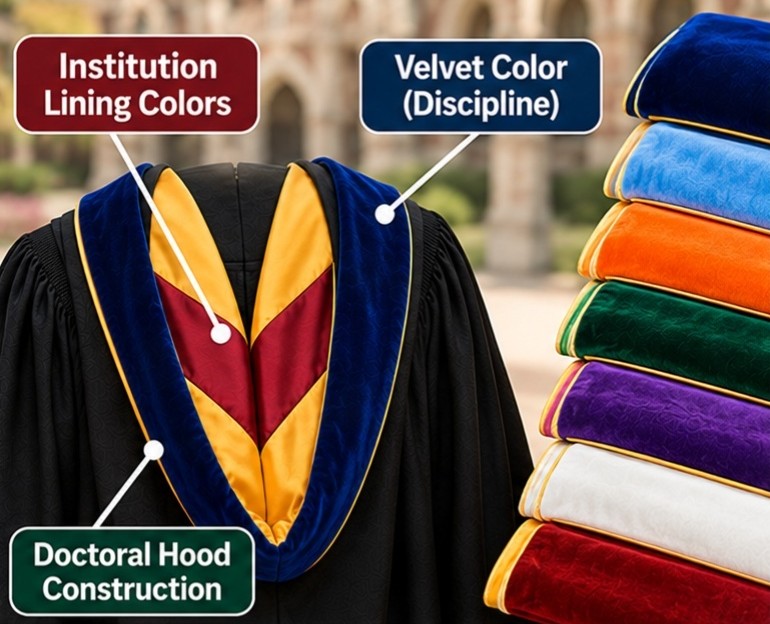
A doctoral academic hood can be one of the most colorful and distinctive pieces of graduation regalia. When several doctoral graduates stand together, their gowns may look similar while their hoods display dramatically different combinations of blue, gold, white, green, orange, purple, pink and other colors.
Those colors are not necessarily decorative choices.
In academic-dress traditions that use standardized hood conventions, different parts of an academic hood can communicate different information. The lining can be associated with the degree-granting institution, while velvet or similar edging can be associated with the academic discipline represented by the degree.
However, academic dress is not completely uniform across every university. Institutions can establish their own regalia requirements, and modern or interdisciplinary doctoral programs can make color classification more complicated.
This guide explains doctoral hood colors, what different parts of the hood can mean, common traditional academic discipline colors, and how doctoral graduates can determine the correct hood for their degree.
What Is a Doctoral Academic Hood?
A doctoral academic hood is a component of doctoral-level graduation regalia worn over the gown and extending down the graduate’s back.
Depending on the academic-dress system, a hood can communicate information through its:
- Shape and degree-level construction
- Outer shell
- Interior lining
- Velvet or similar edging
- Color arrangement
The hood should be viewed as a complete academic garment rather than simply a colorful graduation accessory.
Why Do Doctoral Hoods Have Different Colors?
One reason doctoral hoods look so different is that a hood can potentially communicate more than one piece of academic information.
A useful way to understand it is:
- Hood construction: can relate to academic degree level.
- Hood lining: can identify the degree-granting institution in systems using institutional colors.
- Velvet or edging: can represent the academic discipline under traditional color conventions.
This distinction is essential because people often assume that every color on a hood represents the graduate’s major or field of study.
That is not necessarily the case.
The Two Color Areas You Should Understand First
When examining a doctoral hood, focus first on two areas:
1. Interior Lining
This is the colorful fabric displayed inside the hood and usually visible across the graduate’s back.
2. Velvet or Edging
This is the prominent trim around the hood opening.
These areas can have different meanings.
What Do the Colors Inside a Doctoral Hood Mean?
In academic-dress systems using institutional lining colors, the hood lining can represent the institution that awarded the degree.
For example, an institution may use:
- One primary lining color
- Two institutional colors
- A chevron
- Multiple chevrons
- A divided arrangement
- Another specified color pattern
The arrangement can matter just as much as the colors themselves.
University Colors vs. Academic Hood Lining Colors
One common mistake is assuming that the colors seen on a university’s website or athletic uniforms automatically determine the academic hood lining.
That is not a reliable ordering method.
A university may have several branding colors, and its formal academic-dress specifications may use a particular combination or arrangement.
Always verify the actual hood specification with the degree-granting institution.
Why Does the Hood Lining Have a Chevron?
Some academic hoods use a chevron or similar arrangement to display multiple institutional colors.
This helps create a recognizable institutional configuration.
Two institutions might even use similar colors but arrange them differently.
For this reason, selecting the right colors but the wrong arrangement can still result in an incorrect hood.
What Does the Velvet on a Doctoral Hood Mean?
Under commonly referenced U.S. academic-dress traditions, the velvet or similar edging can be associated with the academic discipline represented by the degree.
This is the area many people mean when they ask about “degree colors.”
However, the correct discipline should not always be inferred from the graduate’s department, concentration or job title.
The institution awarding the degree should determine the appropriate academic-dress classification.
Traditional Academic Discipline Colors
The following are examples of traditional discipline-color associations commonly referenced in U.S. academic dress:
- Arts, Letters and Humanities: White
- Business, Commerce and Accountancy: Drab
- Education: Light Blue
- Engineering: Orange
- Fine Arts: Brown
- Law: Purple
- Library Science: Lemon
- Medicine: Green
- Music: Pink
- Nursing: Apricot
- Philosophy: Dark Blue
- Physical Education: Sage Green
- Public Administration: Peacock Blue
- Public Health: Salmon Pink
- Science: Golden Yellow
- Social Science: Citron
- Theology and Divinity: Scarlet
Important: This list is a general educational reference to traditional academic color associations. It should not be treated as a universal ordering chart. Universities can classify degrees differently or use institution-specific academic dress.
Why Is Dark Blue Associated With PhD Regalia?
Dark blue is traditionally associated with philosophy in commonly referenced U.S. academic-dress color conventions.
This connection can cause confusion because “PhD” stands for Doctor of Philosophy even when the doctoral research is conducted in another academic area.
Graduates should not automatically select dark blue velvet merely because their degree abbreviation is PhD.
The degree-granting institution should confirm the appropriate hood specification.
Does Every PhD Graduate Wear Dark Blue Hood Velvet?
No universal rule should be assumed.
Institutional practices and degree classifications vary.
A doctoral graduate should obtain the actual academic-regalia requirements for the specific degree rather than relying solely on the letters “PhD.”
What Color Hood Does a Doctor of Education Wear?
Light blue is traditionally associated with education in commonly referenced academic color conventions.
However, an EdD graduate should still confirm the required hood color and configuration with the degree-granting institution.
Do not order solely from a general color chart.
What Color Hood Does a Doctor of Business Wear?
Drab is traditionally associated with business, commerce and accountancy.
A business-related doctorate can nevertheless have institution-specific requirements, especially when a program crosses disciplines such as leadership, analytics, technology or management.
What Color Hood Does a Doctor of Engineering Wear?
Orange is traditionally associated with engineering.
Doctoral graduates in engineering-related programs should verify whether their particular degree uses that traditional association or another institutionally specified color.
What Color Hood Does a Doctor of Nursing Wear?
Apricot is traditionally associated with nursing.
Because doctoral healthcare education includes multiple degree types and disciplines, graduates should confirm their specific hood requirements rather than assuming every healthcare doctorate uses the same color.
What Color Hood Does a Doctor of Medicine Wear?
Green is traditionally associated with medicine.
Medical and health-related doctoral programs can differ considerably, so the correct academic dress should be verified with the institution.
What Color Hood Does a Law Graduate Wear?
Purple is traditionally associated with law.
As with other disciplines, the institution’s current academic-dress requirements should control the actual regalia worn at commencement.
What Color Hood Does a Doctor of Science Wear?
Golden yellow is traditionally associated with science.
However, modern science-related doctoral programs can span numerous fields and interdisciplinary areas.
The correct classification should come from the degree-granting institution.
Why Degree Title Matters More Than Your Job
A graduate’s occupation does not necessarily determine the academic hood color.
For example, someone working in healthcare administration might hold a degree classified under business, public administration, health sciences or another field.
Academic dress represents the degree being conferred, not simply the graduate’s current profession.
Major vs. Degree: Which Determines the Hood Color?
This distinction can be important.
A student’s major, concentration, department and formal degree classification are not always identical.
Consider a hypothetical graduate studying data analytics.
The program might award a degree classified by the university under:
- Business
- Science
- Engineering
- Information-related studies
- Another academic area
The program name alone does not reliably determine the academic hood color.
Interdisciplinary Doctoral Programs Can Be Especially Complicated
Modern doctoral education often combines disciplines.
Examples can include:
- Healthcare leadership
- Educational technology
- Business analytics
- Engineering management
- Public health policy
- Organizational leadership
- Biomedical science
- Technology management
Trying to assign a hood color by choosing whichever subject sounds closest can lead to mistakes.
Ask the university which academic color it assigns to the degree.
Can Two PhD Graduates From the Same University Have Different Hood Colors?
Yes.
The institutional lining may be similar because both degrees were awarded by the same institution, while the discipline-related edging can differ depending on the degrees being represented.
This is one reason a doctoral procession can display many different hood colors even among graduates from the same university.
Can Two Graduates in the Same Field Have Different Hood Linings?
Yes.
If they earned degrees from different institutions, their hood linings may differ even when their discipline-related edging is similar.
This illustrates the two-part nature of many academic hood color systems:
Institution + academic discipline.
Doctoral Hood Colors vs. Doctoral Gown Colors
Do not confuse the hood’s academic colors with the color of the doctoral gown.
A graduate might wear a black gown while the hood contains several different colors.
Another university may use a custom-colored doctoral gown.
The gown and hood should each be verified according to their own specifications.
Does the Velvet on the Gown Have to Match the Hood?
Not necessarily.
Doctoral gowns can use black velvet or other approved velvet colors depending on the academic-dress system and institution.
Do not assume the gown velvet and hood edging must always be identical.
Doctoral Hood Colors vs. Tassel Colors
Tassel color is another separate consideration.
A gold-colored doctoral tassel does not necessarily mean the academic hood should also use gold.
The tassel, gown and hood can each follow different institutional specifications.
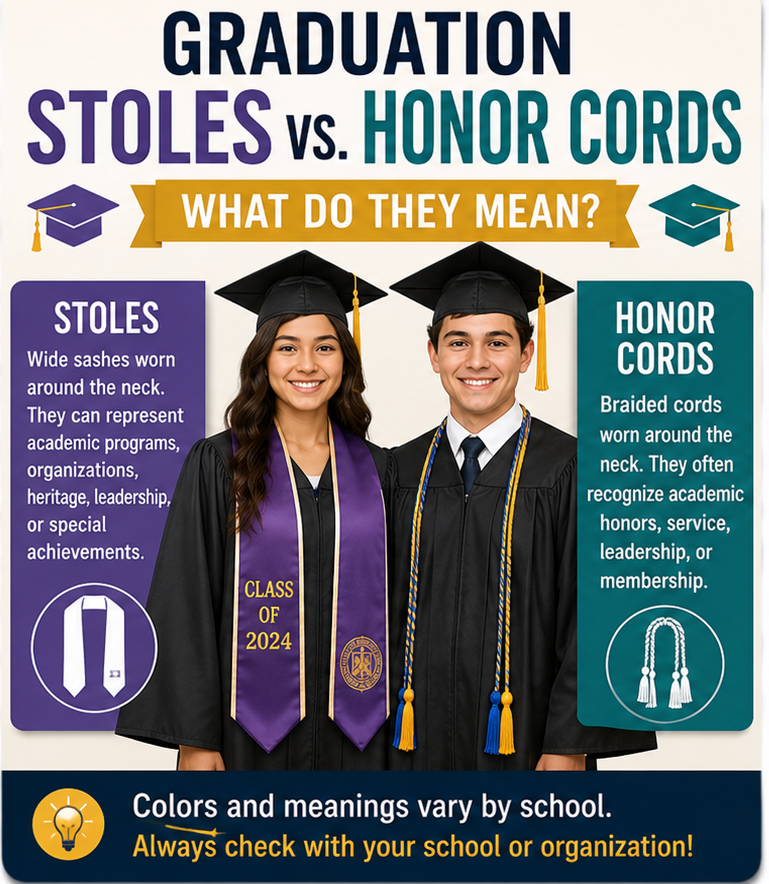
Doctoral Hood Colors vs. Stole Colors
A graduation stole is different from an academic hood.
Stoles may represent:
- Organizations
- Programs
- Recognition
- Affiliations
- Cultural or affinity groups
- Other institution-approved distinctions
The colors of a stole should not be used to determine the correct doctoral hood colors.
Doctoral Hood Colors vs. Honor Cord Colors
Honor and recognition cords are also separate from the academic hood.
A cord’s color may have a particular meaning within an institution or organization, but that meaning does not automatically transfer to the academic hood.
How to Determine Your Correct Doctoral Hood Colors
Use a verification process instead of guessing.
Step 1: Write Down Your Exact Degree
Use the complete official degree title, not just your department or concentration.
Step 2: Identify the Degree-Granting Institution
The institution matters because the hood lining may represent it.
Step 3: Find Current Academic Regalia Instructions
Look for guidance from your university’s commencement office, graduate school, registrar or another office responsible for academic dress.
Step 4: Ask for the Hood Specification
If the information is unclear, ask specifically about:
- Doctoral hood construction
- Outer shell color
- Lining colors
- Lining arrangement
- Velvet or edging color
Step 5: Verify the Academic Discipline
Do not independently classify an interdisciplinary degree if the university can provide the correct academic-dress classification.
Step 6: Compare the Specification With the Product
If purchasing online, compare each part of the hood rather than relying on a product title such as “PhD hood.”
A Simple Doctoral Hood Specification Worksheet
- Degree: __________________________
- Institution: __________________________
- Degree level: Doctoral
- Hood shell: __________________________
- Lining color 1: __________________________
- Lining color 2: __________________________
- Lining arrangement: __________________________
- Velvet/edging color: __________________________
- Institutional source verified: Yes / No
Do Not Order a Hood From a Graduation Photo Alone
Photographs can be useful for understanding how a hood looks when worn, but they are not always reliable specifications.
Photography can alter colors because of:
- Lighting
- Camera exposure
- Editing
- Screen settings
- Fabric reflection
- Age of the regalia
Two similar colors can appear identical in a photograph while representing different specifications.
Academic Color Names Can Be Surprisingly Specific
Traditional academic color terminology can include shades such as:
- Drab
- Citron
- Apricot
- Peacock blue
- Salmon pink
- Sage green
- Golden yellow
Do not substitute an ordinary color simply because its name sounds similar.
If a particular shade is required, use the specified academic color.
Why “Blue” Is Not Specific Enough
Academic regalia can involve several different blues.
For example, traditional associations can include dark blue, light blue and peacock blue for different academic areas.
Therefore, an instruction that simply says “blue” may require clarification before ordering.
Why “Yellow” Is Not Specific Enough
Similar issues can occur with yellow-related colors.
Golden yellow and lemon, for example, traditionally represent different academic areas.
Use the exact specification.
Why “Green” Is Not Specific Enough
Traditional academic color systems can distinguish among colors such as green and sage green.
Do not assume that any green shade is interchangeable.
Custom Doctoral Academic Hoods
Some graduates may need a hood configured for a particular institution and academic discipline.
Before ordering a custom hood, verify every specification carefully.
Custom merchandise can have different production times and return policies from standard stocked products.
Information to Have Before Ordering a Custom Doctoral Hood
Prepare:
- Exact degree title
- Degree abbreviation
- Degree-granting institution
- Academic discipline classification
- Required shell
- Required lining colors
- Required lining arrangement
- Required edging color
- Any institution-specific requirements
Should an Online Retailer Guess Your Hood Colors?
A retailer can help explain available options, but graduates should provide verified institutional specifications whenever possible.
Do not rely on a seller to determine a complex degree classification from a program title alone.
Common Doctoral Hood Color Mistakes
- Assuming every PhD uses the same hood
- Automatically selecting dark blue because the degree says PhD
- Using athletics colors for the hood lining
- Using a university logo to guess lining colors
- Choosing the discipline color from the graduate’s job title
- Choosing from the department name rather than the official degree classification
- Ignoring the lining arrangement
- Confusing gown velvet with hood edging
- Confusing stole colors with academic hood colors
- Confusing honor cord colors with hood colors
- Ordering from an online photograph without verification
- Assuming similar color names are interchangeable
How to Check Your Doctoral Hood When It Arrives
Inspect the hood as soon as possible rather than waiting until commencement day.
Compare it with your verified specification.
Check:
- Doctoral-level construction
- Shell color
- Lining colors
- Lining arrangement
- Velvet or edging color
- Overall condition
Try the Hood With Your Doctoral Gown
A hood can look very different when it is actually worn.
Try on the complete ensemble and examine it from the back.
If possible, ask someone to take a photograph so you can check the hood’s position and visible lining.
Follow Your University’s Hooding Instructions
Some doctoral ceremonies formally place the hood on the graduate during the event.
Others may instruct graduates to arrive wearing it.
Do not assume that procedures from another institution apply to your ceremony.
Doctoral Hood Colors From Cap and Gown Outlet
Cap and Gown Outlet is an independent academic regalia retailer serving individual graduates and qualifying group and institutional customers.
Depending on current product availability, academic regalia may include:
- Doctoral academic hoods
- Doctoral graduation gowns
- Doctoral tams
- Graduation tassels
- Doctoral regalia packages
- Master’s academic hoods
- Master’s graduation regalia
- Bachelor’s graduation regalia
- Graduation stoles
- Honor and recognition cords
- Diploma covers
Available hood colors, lining combinations, edging colors, sizes and customization options vary by product.
Before purchasing a doctoral hood, graduates should compare the selected configuration with the current academic-regalia requirements supplied by their degree-granting institution.
Independent Retailer Disclosure
Cap and Gown Outlet is an independent academic regalia retailer and is not affiliated with, sponsored by, endorsed by or officially authorized by any college or university unless an actual relationship has been established.
The availability of a particular academic hood, lining combination, velvet color or doctoral regalia product does not establish that it is approved for a specific institution, degree or commencement ceremony.
Frequently Asked Questions About Doctoral Hood Colors
What do doctoral hood colors mean?
In academic-dress systems using traditional conventions, the hood lining can represent the degree-granting institution while the velvet or similar edging can represent the academic discipline. Institutional practices vary.
What color is a PhD hood?
There is no single complete hood color for every PhD graduate. A hood can combine institutional lining colors with discipline-related edging, subject to the university’s requirements.
Why is dark blue associated with a PhD?
Dark blue is traditionally associated with philosophy in commonly referenced academic color conventions. Graduates should still verify the required color for their specific PhD program.
Does every PhD graduate wear dark blue velvet?
No universal assumption should be made. Degree classifications and institutional academic-dress practices can vary.
What part of an academic hood represents the university?
In systems using institutional colors, the hood lining can represent the degree-granting institution.
What part of the hood represents the degree?
In commonly referenced U.S. academic-dress traditions, the velvet or similar edging can be associated with the academic discipline represented by the degree.
Why does my doctoral hood have two or more colors?
Multiple colors may be used in the institutional lining, while another color may appear in the discipline-related edging. The exact configuration depends on the institution and academic-dress system.
What does light blue mean on an academic hood?
Light blue is traditionally associated with education. Whether it is correct for a particular graduate should be confirmed with the degree-granting institution.
What does orange mean on an academic hood?
Orange is traditionally associated with engineering.
What does purple mean on an academic hood?
Purple is traditionally associated with law.
What does green mean on an academic hood?
Green is traditionally associated with medicine, while other green shades can have different traditional associations. Verify the exact academic color required.
What does apricot mean on an academic hood?
Apricot is traditionally associated with nursing.
What does golden yellow mean on an academic hood?
Golden yellow is traditionally associated with science.
Can I determine my hood color from my major?
Not reliably. The formal degree classification used for academic dress may differ from a major, concentration or department name.
Can I use my university’s logo colors for my hood?
Do not use logo or athletics colors as a substitute for the institution’s formal academic hood specification.
Can I order a doctoral hood separately from the gown?
Depending on the retailer and product line, doctoral academic hoods may be available separately. Verify the exact hood specification before ordering.
Understanding Doctoral Hood Colors Without Guessing
Understanding doctoral hood colors becomes much easier when you stop thinking of the hood as one multicolored garment and begin looking at its individual components.
The lining and the velvet edging can serve different purposes. In academic-dress systems using traditional conventions, the lining can identify the degree-granting institution while the edging can identify the academic discipline.
That explains why two doctoral graduates from the same university can have different-looking hoods—and why two graduates in similar fields from different universities can also look different.
Traditional academic color associations can help explain the history and visual language of academic dress, but they should not replace your university’s actual specifications.
Before ordering a doctoral hood, confirm your exact degree, institution, hood lining, lining arrangement and discipline-related edging.
That verification is the most reliable way to ensure the colors on your doctoral hood represent the academic regalia required for the degree you earned.