Government education and training programs may recognize many different types of achievement, including GED completion, adult education, vocational training, workforce development, career and technical education, college completion, apprenticeship training and other educational milestones.
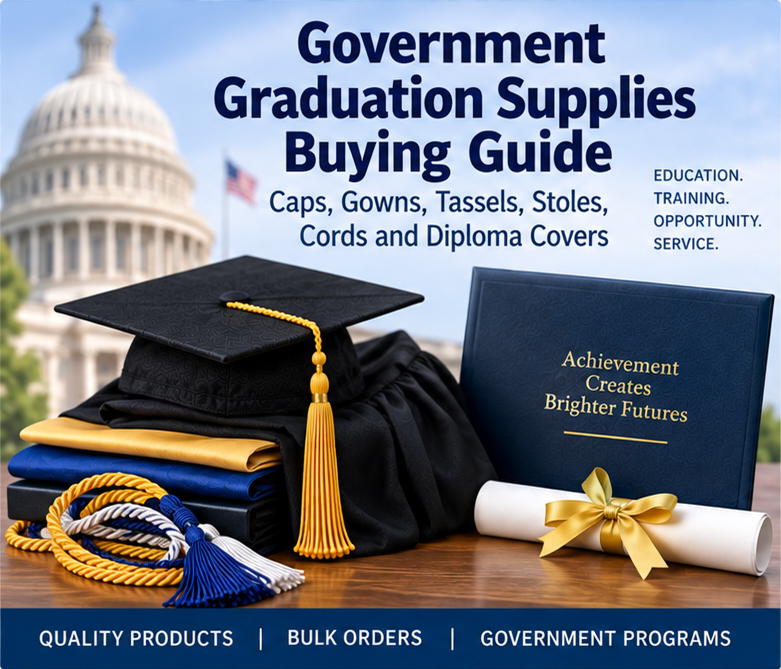
Planning these ceremonies often requires more than selecting a graduation Masters gown. Programs may need caps, tassels, stoles, recognition cords, certificate or diploma covers and, for some degree programs, specialized academic regalia.
This government graduation supplies buying guide explains what purchasing and program personnel should consider when selecting each major product category, determining quantities, preparing specifications and organizing an institutional order.
Start With the Ceremony Requirement
Before choosing individual products, define the ceremony and participant population.
Document information such as:
- Type of education or training program
- Credential or achievement being recognized
- Expected number of participants
- Confirmed participant count
- Ceremony date
- Required merchandise arrival date
- Number of ceremony locations
- Required graduation products
- Approved colors
- Customization requirements
This information becomes the foundation for product specifications, supplier quotations and purchasing quantities.
Who May Need Government Graduation Supplies?
Graduation and recognition merchandise can potentially support ceremonies organized by many types of public-sector education and training programs.
Examples may include:
- GED and high school equivalency programs
- Adult education programs
- Public high schools
- Community colleges
- Career and technical education programs
- Vocational training programs
- Workforce development programs
- Apprenticeship and skills-training programs
- Reentry education programs
- Correctional education programs
- Juvenile education programs
- Veterans education and training programs
- Tribal education and training programs
- Government employee education programs
- Other public education and certificate programs
The appropriate products and purchasing process depend on the specific organization, program, credential and ceremony.
1. Graduation Gowns
The graduation gown is usually the most visible component of ceremony apparel and often represents the largest portion of a bulk regalia order.
Government buyers should define the gown before collecting final sizes or requesting supplier pricing.
Choose the Appropriate Gown Type
Possible categories include:
- Standard graduation gowns
- High school-style gowns
- Bachelor’s gowns
- Master’s gowns
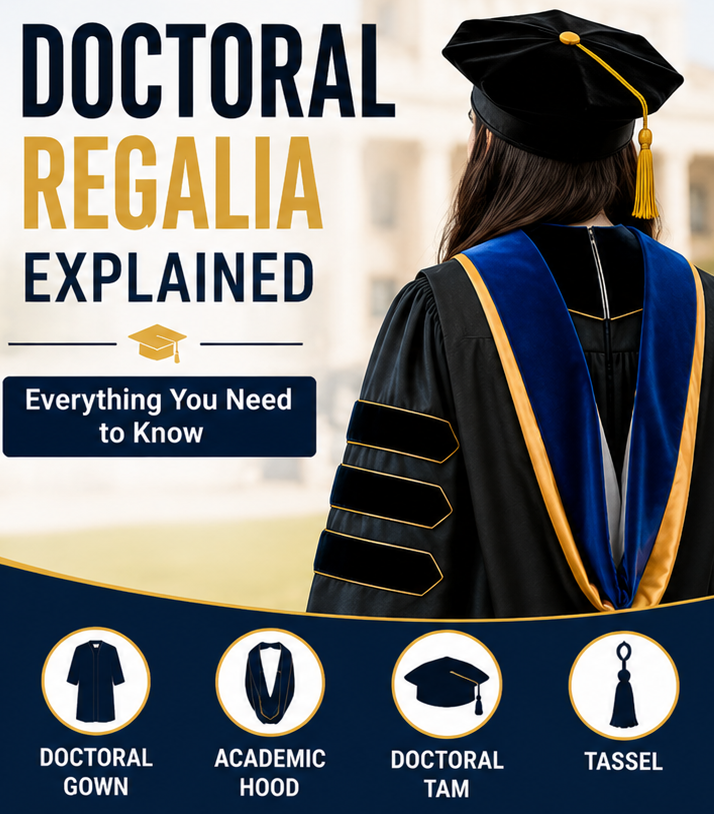
- Doctoral gowns
GED, vocational, workforce and certificate programs should not automatically use degree-level academic gowns simply because the participants are completing an educational program.
Select apparel appropriate to the credential and ceremony.
Choose the Gown Color
There is no universal gown color for all government education or training programs.
The responsible organization should establish its required color.
If several programs participate in one ceremony, determine whether they will use:
- One common color
- Different colors by program
- Different gown styles by credential
Compare Gown Material and Finish
When comparing suppliers, determine whether proposed gowns are equivalent.
Relevant characteristics can include:
- Material
- Matte or shiny finish
- Construction
- Sleeve design
- Closure
- Color
- Academic level
Use the Actual Gown’s Size Chart
Graduation gown sizing can vary by product.
Choose or identify the gown first and then use its current product-specific sizing instructions.
Do not assume ordinary clothing sizes such as small, medium or large apply unless the selected product specifically uses that system.
Check Extended Sizes
Review the complete size range before standardizing a gown.
Determine:
- Available standard sizes
- Available extended sizes
- Availability in the required color
- Pricing differences where applicable
- Processing differences where applicable
2. Graduation Caps
The traditional mortarboard is commonly paired with graduation gowns, but the purchasing organization should still specify exactly what it requires.
Questions to Ask About Graduation Caps
- What cap style is required?
- What color is required?
- Is the cap adjustable or sized?
- Is a tassel included?
- Does the cap match the gown color?
- How many caps are required?
Do Not Automatically Order One Cap Per Gown
Although many ceremonies use one cap for each gown wearer, calculate caps separately.
Some participants may already have approved headwear, while some academic programs may require different headwear.
Doctoral Tams and Other Academic Headwear
Doctoral programs may use a tam or another institution-approved form of academic headwear instead of a standard mortarboard.
Verify the degree-granting institution’s requirements before purchasing.
3. Graduation Tassels
Tassels are small products, but incorrect color, quantity or configuration can create problems close to the ceremony.
Define the Tassel Requirement
Document:
- Tassel color
- Quantity
- Dated or undated style
- Year charm where required
- Whether the tassel is included with a cap or package
Avoid Duplicate Tassel Ordering
If a cap-and-gown package already includes a tassel, do not automatically add a separate tassel quantity.
Review package contents before calculating the final order.
Do Tassel Colors Have Universal Meanings?
No single commercial tassel-color system applies universally to every government education, GED, vocational or workforce ceremony.
For college degree programs, verify institution-specific academic dress requirements.
For non-degree completion programs, the sponsoring organization should establish the appropriate ceremony colors.
4. Graduation Stoles
Graduation stoles can provide a visible way to recognize programs, cohorts or achievements when their use is approved by the organization conducting the ceremony.
Standard Graduation Stoles
For plain stoles, specify:
- Color
- Style
- Quantity
- Material where relevant
Custom Graduation Stoles
Customized stoles require additional planning.
Determine:
- Quantity
- Stole color
- Artwork
- Text
- Printing or embroidery requirements
- Setup charges
- Minimum quantities
- Proof process
- Production schedule
Confirm Permission for Logos and Seals
Before requesting a government seal, school logo, Tribal mark, college mark or other protected artwork on a stole, verify appropriate authorization for the intended use.
A supplier’s ability to reproduce artwork does not establish permission to use it.
5. Honor and Recognition Cords
Recognition cords may be used to distinguish particular achievements, programs or participant groups when established by the sponsoring organization.
Specify Cord Requirements
Document:
- Color or color combination
- Quantity
- Construction where relevant
- Who receives the cord
- Distribution method
Do Cord Colors Mean the Same Thing Everywhere?
No. A cord color should not automatically be assigned a universal academic or achievement meaning across government programs.
The responsible institution or program should determine its recognition criteria and approved colors.
6. Diploma and Certificate Covers
Diploma and certificate covers can provide a finished presentation for credentials distributed during a ceremony.
However, the document dimensions should be verified before the covers are purchased.
Measure the Actual Document
Determine:
- Document width
- Document height
- Portrait or landscape orientation
- Cover dimensions
- Cover color
- Quantity
Do not rely solely on descriptions such as “standard certificate” or “standard diploma.”
Plain vs. Customized Covers
Plain covers may be appropriate when programs need flexible, standard merchandise.
Customized covers may include authorized text or artwork but can involve:
- Minimum quantities
- Setup charges
- Artwork requirements
- Proof approval
- Longer production schedules
7. Academic Hoods
Academic hoods should be treated separately from standard ceremony accessories.
They may be required for certain degree programs according to the academic dress policies of the degree-granting institution.
Before ordering, verify:
- Degree level
- Institution requirements
- Discipline or field requirements where applicable
- Hood design
- Required colors
Do All Bachelor’s Graduates Need Hoods?
No. Many institutions do not use academic hoods for bachelor’s graduates, while others may have different practices.
Verify the institution’s requirements rather than automatically adding a hood to every bachelor’s package.
8. Cap, Gown and Tassel Packages
Purchasing products as a package can simplify ordering when the included components match the program’s requirements.
Before comparing package prices, identify exactly what each package contains.
Package Comparison Questions
- Is the gown included?
- Is the mortarboard included?
- Is the tassel included?
- Is a year charm included?
- What gown sizes are available?
- Are extended sizes available?
- Are all required colors available?
9. Determine Quantities by Product
Do not assume every graduation product needs the same quantity.
Create separate totals for:
- Gowns by size
- Caps
- Tassels
- Stoles
- Cords
- Certificate covers
- Diploma covers
- Academic hoods
- Doctoral tams
Build Quantities From Confirmed Participants
Enrollment totals may not accurately represent ceremony attendance.
Where practical, distinguish:
- Estimated participants
- Eligible participants
- Confirmed participants
- Participants requiring each product
10. Review Existing Graduation Inventory
Government organizations conducting recurring ceremonies may already have reusable merchandise.
Physically verify existing inventory before deducting it from the new requirement.
Track:
- Product
- Color
- Size
- Quantity
- Condition
- Storage location
Calculate the Net Purchasing Requirement
For compatible reusable products:
Confirmed requirement − verified usable inventory = net purchasing requirement.
For gowns, perform this calculation by size.
11. Standard vs. Customized Graduation Supplies
Separate standard stocked merchandise from customized products during purchasing.
Standard merchandise may offer simpler replenishment and shorter processing schedules, depending on current inventory.
Custom merchandise may require:
- Artwork preparation
- Proof approval
- Minimum quantities
- Production time
- Setup charges
12. Request Product Specifications
For institutional purchasing, descriptions should be specific enough to determine what is being offered.
A product specification might include:
- Product type
- Style
- Material
- Color
- Size
- Quantity
- Included accessories
- Customization
- Packaging requirements
13. Request an Itemized Graduation Supplies Quote
When appropriate under the organization’s purchasing process, ask suppliers to identify:
- Product description
- Quantity
- Unit price
- Extended price
- Customization charges
- Shipping or freight
- Other disclosed charges
- Total quoted amount
- Quote expiration
- Expected processing schedule
14. Compare More Than the Gown Price
A low gown price does not necessarily mean the complete requirement has the lowest delivered cost or meets the purchasing organization’s specifications.
Supplier responses may differ in:
- Product specifications
- Package contents
- Size ranges
- Extended sizes
- Inventory availability
- Accessories
- Customization
- Shipping
- Processing schedules
Government purchasing personnel should apply the evaluation basis established for the acquisition.
15. Plan the Delivery Schedule
The required arrival date should normally be earlier than the ceremony date.
Programs may need time for:
- Receiving
- Inspection
- Counting
- Sorting
- Distribution among locations
- Participant distribution
- Approved size corrections
16. Plan Multi-Location Deliveries
Government education programs may operate across several schools, training centers or facilities.
Determine whether merchandise should:
- Ship to one central receiving point
- Be separated by program
- Be packed by location
- Be labeled by gown size
- Ship directly to multiple authorized destinations
Ask suppliers to identify additional packaging or shipping charges associated with the required arrangement.
17. Review Exchange and Return Terms
Before ordering, understand how the supplier handles:
- Gown-size exchanges
- Incorrect products
- Shortages
- Damaged merchandise
- Unused standard merchandise
- Customized merchandise
Custom products may have different return or exchange limitations from standard products.
18. Confirm Purchase-Order Capability When Applicable
If the organization intends to use a purchase order, confirm whether the supplier accepts the applicable institutional or government PO and what terms apply.
Potential questions include:
- Is prior account approval required?
- What payment terms apply?
- Is a minimum order required?
- What documentation is needed?
A supplier accepting purchase orders does not by itself establish government endorsement, approved-vendor status or government contract status.
19. Prepare for Receiving
The purchasing process does not end when the supplier ships the order.
Receiving personnel should have enough information to verify:
- Products
- Quantities
- Gown sizes
- Accessories
- Custom merchandise
- Location allocations
Inspect Merchandise Promptly
Checking products soon after delivery can provide more time to address documented shortages, incorrect products or damage according to the applicable supplier terms.
20. Keep Post-Ceremony Inventory Records
After the ceremony, count reusable merchandise remaining in inventory.
Record:
- Product
- Color
- Size
- Quantity
- Condition
- Storage location
This can improve forecasting for future ceremonies.
Government Graduation Supplies Purchasing Checklist
- Program and ceremony identified
- Credential types identified
- Confirmed participant count established
- Gown type selected
- Gown color established
- Product-specific gown size chart obtained
- Extended sizes reviewed
- Gown quantities calculated by size
- Caps calculated separately
- Tassel specifications established
- Tassel quantities calculated
- Stole requirements established
- Cord requirements established
- Certificate and diploma dimensions verified
- Cover quantities calculated
- Academic hood requirements verified where applicable
- Doctoral headwear requirements verified where applicable
- Package contents reviewed
- Existing usable inventory physically verified
- Net purchasing quantities calculated
- Custom merchandise identified
- Artwork authorization verified where applicable
- Product specifications prepared
- Itemized pricing requested where appropriate
- Shipping requirements established
- Required arrival date established
- Multi-location requirements established
- Exchange and return terms reviewed
- PO acceptance confirmed when applicable
- Receiving process established
- Post-ceremony inventory planned
- Applicable procurement requirements reviewed
- Funding allowability verified when restricted funds are involved
Government Procurement Considerations
Government purchasing organizations should follow the procurement requirements applicable to their jurisdiction, agency, funding source and transaction.
For federal simplified acquisitions, current Federal Acquisition Regulation procedures require consideration of applicable required sources and certain existing contracts before using the simplified acquisition procedures addressed by FAR Part 13. Federal contracting officers are also directed to promote competition to the maximum extent practicable.
Federal quotations or offers under those procedures are evaluated impartially and according to the basis established in the solicitation, with transportation charges from the supplier’s shipping point to the delivery destination included in the evaluation.
State, local and Tribal governments may have different purchasing requirements, contracts, competitive quotation procedures, vendor registrations and approval processes.
Do Not Artificially Divide a Federal Requirement
Federal FAR Part 13 prohibits breaking down a known requirement merely to permit simplified acquisition procedures or avoid requirements that apply above the applicable purchasing threshold.
Other public organizations should follow their own applicable requirements concerning aggregation and purchasing authority.
Vendor Registration and Unique Entity ID
For federal purchasing, a Unique Entity ID should not automatically be treated as proof of completed SAM registration.
SAM.gov distinguishes between obtaining only a Unique Entity ID and completing entity registration. When registration is required for a particular federal transaction, purchasing personnel should verify the applicable status through the appropriate federal system.
Verify Funding Allowability Separately
Graduation supplies being appropriate for a ceremony does not automatically establish that caps, gowns, tassels, stoles, cords or diploma covers are allowable expenses under a particular grant, appropriation or government-funded program.
The responsible organization should verify applicable:
- Law and regulations
- Grant or award terms
- Cost requirements
- Program guidance
- Agency policies
Bulk Graduation Supplies for Government and Institutional Buyers
Cap and Gown Outlet is an independent academic regalia supplier serving individual customers and qualifying institutional purchasers.
Depending on current availability and order requirements, organizations may request product information or quotations for:
- Graduation gowns
- Mortarboard caps
- Graduation tassels
- Cap, gown and tassel packages
- Extended-size gowns where available
- Graduation stoles
- Honor and recognition cords
- Certificate covers
- Diploma covers
- Bachelor’s regalia
- Master’s regalia
- Doctoral regalia
- Academic hoods where applicable
- Doctoral tams where applicable
Formal quotations and quantity-based institutional pricing may be available depending on merchandise and order requirements. Product availability, size ranges, minimum quantities, customization requirements and processing schedules vary by product.
Nationwide U.S. shipping is available. Institutional purchasers should verify current inventory, product specifications, processing schedules, shipping charges and available expedited options for their specific requirement.
If a purchase order will be used, supplier PO acceptance and applicable terms should be confirmed before issuance.
Independent Supplier and Non-Affiliation Disclosure
Cap and Gown Outlet is an independent academic regalia supplier. It is not affiliated with, endorsed by, sponsored by, authorized by or acting on behalf of any federal, state, local or Tribal government, government agency, public institution, educational organization or government-funded program unless an actual official relationship has been established.
References to government education, GED, vocational, workforce, correctional, reentry, veterans, Tribal and other public programs describe potential customer and ceremony types. They do not establish government endorsement, approved-vendor status, contract status, preferred-supplier designation, purchasing eligibility or funding allowability.
Frequently Asked Questions About Government Graduation Supplies
What graduation supplies may a government education program need?
Depending on the ceremony, products may include gowns, mortarboards, tassels, stoles, recognition cords, certificate covers, diploma covers and degree-specific academic regalia where applicable.
Should every participant receive the same graduation products?
Not necessarily. Product requirements can differ by program, credential, recognition category and institution.
How should government programs choose graduation gown sizes?
Select or identify the gown first and use its current product-specific sizing instructions. Avoid assuming ordinary clothing sizes apply to every graduation gown.
Are graduation tassel colors standardized for government programs?
No universal tassel-color system applies to all government education and training programs. The responsible program should establish its ceremony requirements, while degree-granting institutions may have their own academic dress rules.
Can government programs order custom graduation stoles?
Potentially, depending on supplier capabilities and purchasing requirements. Custom orders may involve minimum quantities, artwork, setup charges, proof approval and additional production time.
Can a government logo or seal be placed on graduation supplies?
Only when the intended use is appropriately authorized. A supplier’s ability to reproduce a logo or seal does not itself establish permission to use it.
Are honor-cord colors universal?
No. Organizations should establish their own approved recognition criteria and colors rather than assuming a commercial cord color has the same meaning everywhere.
How should a program choose diploma or certificate covers?
Measure the actual document and confirm its orientation before selecting a cover. Do not rely solely on a generic “standard size” description.
Do all bachelor’s graduates need academic hoods?
No. Academic dress practices vary by institution, and many institutions do not require bachelor’s hoods. Verify the degree-granting institution’s requirements.
Are government graduation supplies automatically eligible for grant funding?
No. The responsible organization should separately determine whether the expense is allowable under the applicable funding authority, award terms, cost requirements and program guidance.
Build the Graduation Supply Order Around the Actual Requirement
A successful government graduation supplies purchase begins with the participants and ceremony rather than with a generic product package.
By defining gown specifications, using product-specific sizing, calculating caps and accessories independently, measuring certificates, identifying customization early and establishing clear delivery requirements, government education and training programs can create a more accurate purchasing requirement for Masters caps and gowns, tassels, stoles, cords and diploma covers.