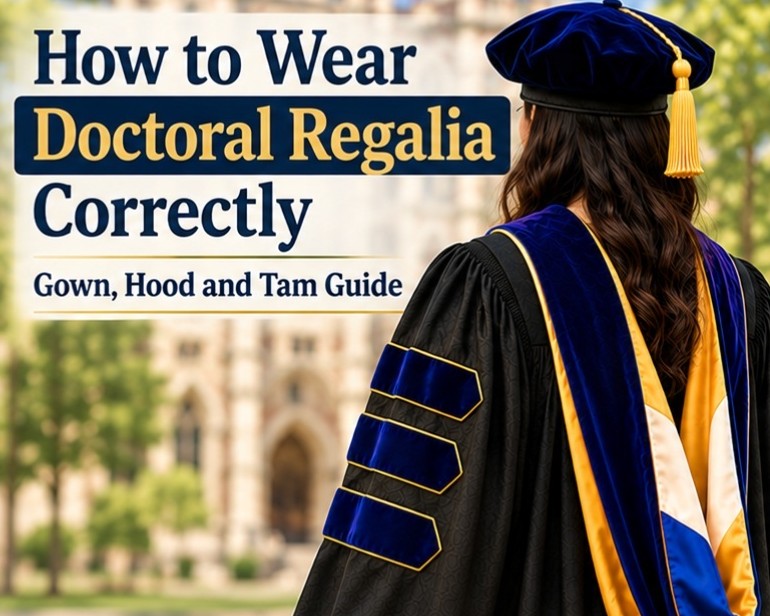
You have the doctoral gown, academic hood, tam and tassel ready for commencement. Now comes another important question: how should everything actually be worn?
Doctoral regalia contains more pieces and details than typical undergraduate academic dress. The gown has distinctive sleeves and velvet elements, the hood needs to drape correctly across the shoulders and back, and the doctoral tam must sit securely without looking awkward or interfering with the tassel.
Putting everything on for the first time immediately before commencement can create unnecessary confusion.
This guide explains how to wear doctoral regalia from the clothing underneath the gown through the final hood and tam adjustments. Because academic-dress practices vary, always follow the current instructions provided by your degree-granting institution and commencement officials when they differ from general guidance.
What Does a Complete Doctoral Regalia Outfit Include?
Depending on the university and doctoral degree, the academic ensemble may include:
- Doctoral graduation gown
- Doctoral academic hood
- Doctoral tam or other approved academic headwear
- Graduation tassel
- Institution-authorized cords, stoles or other distinctions
Not every institution uses exactly the same combination.
Before Getting Dressed: Verify Your Regalia
Before learning how to put the pieces on, confirm that you actually have the correct pieces.
Check your institution’s current requirements for:
- Gown style and color
- Academic hood
- Hood lining and edging
- Tam or mortarboard
- Tassel
- Authorized additional accessories
Correct placement cannot compensate for incorrect academic regalia.
The Recommended Order for Putting On Doctoral Regalia
A practical dressing sequence is:
- Put on your graduation-day clothing and shoes.
- Put on the doctoral gown.
- Add authorized stoles or cords according to institutional instructions.
- Put on or prepare the doctoral academic hood as directed.
- Put on the doctoral tam or approved headwear.
- Attach and position the tassel.
- Perform a complete front-and-back check.
Your university’s hooding ceremony may change when the hood itself is placed on you, so follow ceremony-specific instructions.
Step 1: Choose What to Wear Under the Doctoral Gown
Academic regalia is worn over regular clothing.
Your university may publish a dress code or recommendations for commencement. When it does, those instructions should take priority.
Otherwise, choose clothing that is:
- Appropriate for the ceremony
- Comfortable under the gown
- Suitable for the weather
- Easy to walk and sit in
- Compatible with the gown neckline
Consider the Temperature
Doctoral gowns can contain substantial fabric, especially when they include velvet or velvet-like facings and sleeve bars.
For warm outdoor ceremonies, clothing underneath may need to be lighter. For cold-weather ceremonies, additional layers may be useful.
Remember that you may spend significant time wearing the gown before the ceremony begins.
Choose Shoes for Walking, Not Just Photographs
Commencement can involve more walking than expected.
You may need to:
- Walk across campus
- Stand in a procession line
- Use stairs
- Walk across a stage
- Stand for photographs
- Remain on your feet during portions of the ceremony
Choose footwear that works safely and comfortably with the gown length.
Step 2: Put On the Doctoral Gown
Put your arms through the sleeves carefully and allow the gown to fall naturally from the shoulders.
Make sure the fabric is not twisted around the arms or shoulders.
Once the gown is on, adjust the shoulder area so both sides sit evenly.
Should You Zip the Doctoral Gown?
If your gown has a front zipper or closure, follow your institution’s ceremony instructions and the intended design of the garment.
Many academic gowns are worn closed during formal commencement proceedings, but practices and gown designs can vary.
Check the Velvet Front Facings
Many doctoral gowns feature velvet or velvet-like panels running down the front.
After putting on the gown:
- Straighten both front facings
- Make sure one side is not folded underneath
- Check that the neckline sits evenly
- Allow the gown to hang naturally
Check the Three Sleeve Bars
Many doctoral gowns have three velvet or velvet-like bars on each sleeve.
Make sure the sleeves are not twisted so that these elements sit as intended.
If one sleeve looks noticeably different from the other, rotate or straighten the sleeve rather than pulling aggressively on the fabric.
How Long Should the Doctoral Gown Be?
Exact gown lengths vary by manufacturer and sizing system.
The gown should provide the intended academic appearance without creating an unsafe walking situation.
If the gown reaches the floor, catches under your shoes or significantly interferes with walking, recheck the size before commencement.
Perform a Walking Test
Once the gown is on, walk around the room.
Check:
- Gown length
- Sleeve movement
- Shoulder comfort
- Ability to use stairs
- Whether your shoes catch the hem
Step 3: Add Authorized Cords or Stoles
Some doctoral graduates may be permitted to wear additional recognition items.
These can include:
- Honor cords
- Academic stoles
- Organization stoles
- Institution-specific distinctions
Do not assume every accessory is permitted simply because you own it.
Follow your institution’s commencement policy regarding additional regalia.
When Should Cords and Stoles Go On?
In many outfits, cords or stoles are arranged over the gown before the academic hood is positioned.
However, placement can depend on the specific items and institutional instructions.
If multiple accessories are authorized, test the complete combination before commencement to avoid crowding around the neckline.
Step 4: Understand the Doctoral Hood Before Putting It On
The academic hood can be confusing when it is lying flat.
Before putting it on, identify:
- The opening that goes around the neck
- The portion that extends down the back
- The outer shell
- The interior lining
- The velvet or velvet-like edging
- Any attachment cord or loop
Understanding the hood’s orientation before dressing makes placement much easier.
Which Part of the Doctoral Hood Goes in Front?
The narrow neck portion sits around the graduate’s neck and shoulders.
The larger portion extends down the back.
The hood should not be worn backward with the large section hanging down the chest.
Step 5: Place the Doctoral Hood Around Your Neck
If you are expected to arrive already hooded, carefully place the hood over your head so that the narrow portion sits around the neck and the larger section falls down the back.
Avoid twisting the hood while putting it on.
What If You Are Being Hooded During the Ceremony?
Some doctoral ceremonies formally place the academic hood on the graduate as part of the event.
If your program uses a hooding ceremony, you may be instructed to carry the hood rather than wear it when entering.
Follow the exact instructions provided by your graduate school or commencement organizers.
Do Not Arrive Wearing the Hood If You Were Told to Carry It
This is one reason ceremony-specific instructions are important.
General academic-dress advice should never override the procedures established for your hooding ceremony.
Step 6: Arrange the Hood Across the Shoulders
Once the hood is around the neck, allow it to rest naturally across the shoulders.
The neckline should feel centered rather than pulling heavily to one side.
Check that the hood does not bunch excessively underneath the gown collar.
Step 7: Arrange the Hood Down the Back
The main body of the doctoral hood extends down the graduate’s back.
This is where having another person assist can be especially useful.
Ask your helper to:
- Center the hood
- Remove twists
- Smooth the shell
- Arrange the lining as intended
- Check that both sides appear balanced
Should the Hood Lining Be Visible?
Academic hoods are commonly arranged so that the interior lining is displayed rather than completely hidden.
The exact appearance depends on the hood’s construction.
Instead of forcing the fabric into an unfamiliar shape, follow any instructions supplied with the hood or by your institution.
Why the Hood Lining Matters
In academic-dress traditions commonly used in the United States, hood lining can represent the degree-granting institution.
The arrangement may involve:
- One color
- Two colors
- One or more chevrons
- Another specified pattern
The hood should be arranged so that its intended design can be presented properly.
What About the Velvet Edge?
Doctoral academic hoods commonly feature velvet or velvet-like edging.
In traditional U.S. academic-dress conventions, this edging can be associated with an academic discipline.
Do not alter, fold away or reposition the edging simply to change the appearance.
Step 8: Secure the Hood If the Design Provides an Attachment
Some academic hoods have a small cord, loop or attachment designed to help keep the front from moving backward.
If your hood includes such a feature, follow the manufacturer’s or institution’s instructions for using it.
Avoid attaching the hood to fragile clothing in a way that could damage your garment.
Do Not Pull the Hood Too Tightly
The hood should sit securely without choking the neckline or pulling the gown backward.
If it feels unusually tight, stop and check whether:
- The hood is twisted
- The neck opening is oriented correctly
- An attachment has been fastened incorrectly
- The hood is caught under another garment
Step 9: Check the Hood in a Photograph
A mirror does not provide a good view of your back.
Ask someone to take a photograph from directly behind.
Look for:
- Centered placement
- Visible twists
- Uneven draping
- Incorrect lining arrangement
- Fabric caught under the gown
Step 10: Put On the Doctoral Tam
After the gown and hood are arranged, put on the approved academic headwear.
If your institution uses a doctoral tam, hold it by the sides and lower it onto your head without pulling aggressively on the fabric.
How Should a Doctoral Tam Sit?
The tam should feel secure enough for walking and normal head movement.
It should not:
- Slide easily off the head
- Sit so loosely that it shifts while walking
- Feel painfully tight
- Obstruct your vision
Four-, Six- and Eight-Sided Doctoral Tams
Doctoral tams can be constructed with different numbers of sides, commonly including four-, six- and eight-sided styles.
The number of sides primarily describes the construction and shape of the tam.
It should not automatically be interpreted as indicating academic prestige, honors or rank.
Does the Point of a Tam Face Forward?
Tam construction varies, so avoid applying a single positioning rule to every style.
Use the manufacturer’s instructions or institutional guidance for your specific tam.
The primary goal is for the headwear to sit securely and present the intended shape.
Step 11: Position the Tassel
The tassel attaches to the academic headwear and should hang freely rather than becoming trapped underneath the tam.
Make sure the tassel:
- Is securely attached
- Hangs naturally
- Is not tangled
- Does not interfere with your vision
Which Side Should a Doctoral Tassel Be On?
Follow your institution’s instructions.
Rules and traditions concerning tassel placement and movement can vary by institution and degree level.
Do not automatically follow undergraduate tassel instructions for a doctoral ceremony.
Does a Doctoral Tassel Have to Be Gold?
Gold-colored tassels are commonly seen with doctoral academic dress, but they are not a universal requirement.
Your institution’s current specifications should determine the appropriate tassel.
Step 12: Check the Entire Outfit From the Front
Stand naturally rather than holding the gown in position.
Check:
- Gown centered
- Front facings straight
- Gown closure positioned correctly
- Sleeves untwisted
- Cords or stoles arranged evenly
- Hood neckline centered
- Tam secure
- Tassel hanging freely
Step 13: Check the Entire Outfit From Behind
The rear view is particularly important with doctoral regalia.
Check:
- Hood centered on the back
- Lining displayed properly
- No twists in the hood
- Gown shoulders even
- Back of gown hanging naturally
- Tam sitting securely
Step 14: Check Both Side Views
Side photographs can reveal issues that front and rear photographs miss.
Look for:
- Hood pulling backward excessively
- Tam tilting too far
- Tassel caught in the hood
- Gown bunching around the shoulders
How to Carry a Doctoral Hood Before a Hooding Ceremony
If your university instructs you to carry the hood into the ceremony, follow its specific folding and carrying directions.
Do not improvise a complicated fold that may make it difficult for the faculty member or official performing the hooding.
Some programs provide detailed instructions during rehearsal.
What Happens During a Doctoral Hooding Ceremony?
Procedures vary considerably.
A graduate may be instructed to:
- Approach a designated location
- Hand the hood to a faculty member
- Turn or face a particular direction
- Lower slightly so the hood can pass over the head
- Stand while the hood is arranged
- Proceed across the stage
Follow the directions provided by the ceremony staff.
Do Not Try to Correct the Hood While Someone Is Hooding You
During the formal hooding moment, allow the designated person to place the hood.
If an adjustment is needed afterward, make it discreetly when appropriate or ask an attendant for help.
How to Keep a Doctoral Hood From Sliding Back
If the hood repeatedly pulls backward, first verify that it is oriented correctly.
Then check whether the hood includes an intended attachment mechanism.
Do not use improvised pins or clips without considering the gown, clothing and hood materials, since they can potentially cause damage.
How to Wear Doctoral Regalia With Long Hair
Long hair can interact with both the hood and tam.
Before commencement, test whether your planned hairstyle:
- Interferes with the hood neckline
- Changes the fit of the tam
- Pushes the hood away from the shoulders
- Causes the tam to slide
You do not necessarily need to change your hairstyle. The goal is simply to know how the complete outfit will behave.
How to Wear a Doctoral Tam With Different Hairstyles
Try the tam with approximately the same hair volume you expect on graduation day.
If the tam uses an adjustable or elasticized fit, make adjustments before arriving at the ceremony rather than experimenting while lining up for the procession.
What About Glasses?
Put on the tam while wearing your glasses if you plan to wear them during commencement.
Make sure the headwear does not press the glasses uncomfortably against your head.
Doctoral Regalia and Graduation Photography
Correct placement can make a significant difference in photographs.
Immediately before formal photographs:
- Straighten the gown
- Check the velvet facings
- Center the hood
- Arrange the visible lining
- Check the tam
- Untangle the tassel
Do Not Hide the Hood in Every Photograph
The academic hood is an important visual component of doctoral regalia.
Consider taking photographs from both the front and back so the complete ensemble is documented.
Can You Wear the Doctoral Gown Open for Photos?
For formal academic photographs, follow the intended gown design and any institutional guidance.
You can discuss additional informal poses with your photographer, but your official commencement appearance should follow the institution’s academic-dress expectations.
Common Doctoral Regalia Dressing Mistakes
Mistake 1: Wearing the Hood Backward
The larger portion of the academic hood belongs down the back rather than the chest.
Mistake 2: Leaving the Hood Twisted
A twist can prevent the lining and edging from displaying properly.
Mistake 3: Hiding the Entire Hood Lining
The lining is an intentional part of many academic hood designs and is commonly arranged to be visible.
Mistake 4: Wearing the Tam Too Loosely
Loose headwear may shift during the procession or stage crossing.
Mistake 5: Copying Undergraduate Tassel Rules
Doctoral ceremony instructions may differ.
Mistake 6: Wearing Unapproved Accessories
Not every stole, cord or decorative accessory is necessarily permitted.
Mistake 7: Trying Everything On for the First Time at Commencement
This leaves little time to solve fit or placement problems.
Mistake 8: Ignoring the Rear View
The hood makes the back of doctoral regalia especially important.
Mistake 9: Decorating Academic Headwear Without Checking the Rules
Some institutions restrict decoration of academic caps or tams.
Check before adding anything.
The 10-Minute Doctoral Regalia Dress Rehearsal
Several days before commencement, conduct a complete rehearsal.
Minutes 1–2: Clothing and Shoes
Put on the clothing and footwear you expect to wear.
Minutes 3–4: Gown
Put on the gown, straighten the sleeves and facings, and check the closure.
Minutes 5–6: Hood
Place and arrange the hood if your ceremony requires you to arrive wearing it.
Minute 7: Tam and Tassel
Put on the tam, adjust the fit and check the tassel.
Minute 8: Walk
Walk around and test your range of motion.
Minute 9: Sit
Sit in a chair and stand again.
Minute 10: Photos
Take front, back and side photographs.
Graduation Morning Checklist
- Doctoral gown
- Academic hood
- Doctoral tam or approved cap
- Tassel
- Authorized cords or stoles
- Graduation clothing
- Comfortable ceremony shoes
- Any university-issued commencement credentials
Five-Minute Final Check Before Leaving
Before heading to commencement, verify:
- The gown is the correct one.
- The hood is packed or worn according to ceremony instructions.
- The tam fits securely.
- The tassel is attached.
- All authorized accessories are present.
After Putting Everything On: Use the Gown-Hood-Tam Check
Use this simple three-part review.
GOWN
- Centered?
- Untwisted?
- Facings straight?
- Sleeve bars positioned correctly?
- Safe length for walking?
HOOD
- Correct orientation?
- Centered?
- Untwisted?
- Lining arranged properly?
- Comfortable around the neck?
TAM
- Secure?
- Comfortable?
- Properly positioned for its design?
- Tassel attached?
- Tassel placed according to ceremony instructions?
Doctoral Regalia From Cap and Gown Outlet
Cap and Gown Outlet is an independent academic regalia retailer serving individual graduates and qualifying group and institutional customers.
Depending on current inventory and available configurations, academic-regalia products may include:
- Doctoral graduation gowns
- Doctoral academic hoods
- Doctoral tams
- Graduation caps
- Graduation tassels
- Doctoral regalia packages
- Master’s graduation regalia
- Bachelor’s graduation regalia
- Graduation stoles
- Honor and recognition cords
- Diploma covers
Styles, fabrics, colors, sizing, hood configurations, tam construction and package contents vary by product.
Graduates purchasing academic regalia independently should verify their degree-granting institution’s current requirements before ordering.
Independent Retailer Disclosure
Cap and Gown Outlet is an independent academic regalia retailer and is not affiliated with, sponsored by, endorsed by or officially authorized by any college or university unless an actual relationship has been established.
The availability of a doctoral gown, hood, tam, tassel or other academic-regalia product does not establish that it is approved for a particular institution, doctoral program or commencement ceremony.
Frequently Asked Questions About Wearing Doctoral Regalia
How do you wear doctoral regalia?
Generally, put on your ceremony clothing first, followed by the doctoral gown, authorized accessories, academic hood when appropriate, and approved headwear with tassel. Follow your university’s specific commencement instructions.
How do you wear a doctoral gown?
Place both arms through the sleeves, settle the gown evenly across the shoulders, straighten the front facings and sleeves, and use the gown’s closure as intended and as directed for the ceremony.
How do you wear a doctoral hood?
The narrow portion sits around the neck and shoulders while the larger portion extends down the back. The hood should be centered and arranged without twists. Follow institutional instructions for displaying the lining.
Do doctoral graduates put the hood on before commencement?
Not always. Some graduates arrive wearing the hood, while others carry it for a formal hooding ceremony. Follow the instructions for your specific event.
Should the doctoral hood lining show?
Academic hoods are commonly arranged so that the lining is visible, but the exact presentation depends on the hood’s construction and institutional practice.
How do you keep an academic hood in place?
First make sure it is correctly oriented and untwisted. If the hood includes an attachment mechanism, use it according to the manufacturer’s or institution’s instructions.
How should a doctoral tam fit?
It should feel secure and comfortable during walking and normal head movement without obstructing vision or creating excessive pressure.
Which way should a doctoral tam face?
Tam designs vary. Follow the manufacturer’s instructions or your institution’s guidance for the specific style.
Which side does a doctoral tassel go on?
Follow your institution’s ceremony instructions because tassel-placement traditions can differ by institution and degree level.
Does a doctoral tassel have to be gold?
No universal requirement should be assumed. Gold-colored tassels are common, but institutional specifications vary.
Can doctoral graduates wear honor cords and stoles?
Potentially, when authorized by the institution. Check the commencement policy before adding accessories.
Can I decorate my doctoral tam?
Check your institution’s rules first. Some universities restrict or prohibit decoration of academic headwear.
What should I wear underneath a doctoral gown?
Follow any institutional dress requirements and choose ceremony-appropriate clothing that remains comfortable under the gown and suits the weather.
Should I practice wearing doctoral regalia before graduation?
Yes. A full dress rehearsal can reveal problems with gown length, hood placement, tam fit, footwear and movement while there is still time to address them.
How can I tell whether my doctoral hood is positioned correctly?
Check that it is centered, untwisted and comfortably positioned around the neck, then use a rear photograph to inspect the drape and lining arrangement.
Wear Your Doctoral Regalia With Confidence
Learning how to wear doctoral regalia correctly is easier when you treat the gown, hood and tam as three separate components before combining them into one complete academic outfit.
Start with the gown. Make sure it hangs evenly, the sleeves are not twisted and the front facings sit correctly.
Next, focus on the academic hood. Verify its orientation, center it across the shoulders and arrange the back according to its construction and your institution’s instructions.
Finally, put on the doctoral tam or other approved headwear, check the fit and position the tassel according to the ceremony instructions.
Most importantly, practice before graduation day.
A short dress rehearsal with front, back and side photographs can identify nearly every common placement problem while you still have time to correct it.
When commencement arrives, you can spend less time adjusting your academic dress and more time appreciating the achievement the regalia represents.