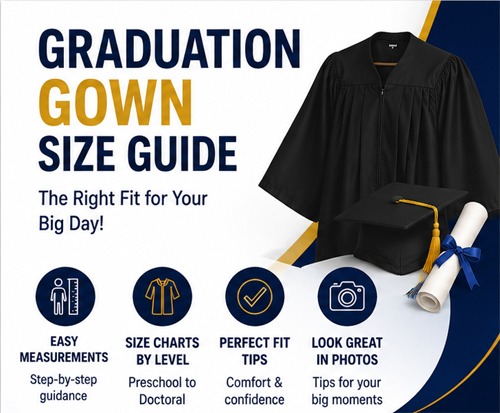
Accurate graduation gown sizing is one of the most important parts of planning an institutional graduation order. A government education or training program may select the correct Bachelors gown style, color and quantity, but incorrect sizing can still create exchanges, late replacement orders and unnecessary complications before the ceremony.
A structured process for graduation gown sizing for government education programs can help public-sector organizations collect participant information consistently, calculate quantities by size and prepare a more accurate institutional order.
The most important rule is simple: use the current sizing chart and instructions for the exact graduation gown being purchased. Graduation gowns do not necessarily follow ordinary clothing sizes, and sizing methods can vary between products and suppliers.
Why Graduation Gown Sizing Should Begin Early
Graduation gown sizing should not be left until the final purchasing deadline. Starting early provides time to:- Confirm the expected participant roster
- Select the intended gown
- Obtain the correct product-specific size chart
- Collect required sizing information
- Follow up on incomplete submissions
- Identify extended-size requirements
- Calculate quantities by size
- Review the final order before purchasing
Step 1: Select the Graduation Gown Before Collecting Sizes
Programs should generally avoid collecting gown sizes before deciding which gown they intend to purchase. Different products may use different sizing systems. One gown may be sized primarily according to height, while another product may require additional information or use different size ranges. First identify the proposed gown and review its current sizing instructions.Step 2: Obtain the Current Product-Specific Size Chart
Do not rely on an old size chart from a previous ceremony unless it has been confirmed for the current product. Before collecting participant information, verify:- Available gown sizes
- Height ranges
- Any additional sizing criteria required by the product
- Extended-size options
- Any special sizing instructions
Do Not Assume Graduation Gown Sizes Equal Clothing Sizes
Everyday labels such as Small, Medium, Large or XL may not correspond directly to the sizing system used for a particular graduation gown. A participant’s shirt, jacket, dress or other normal clothing size should not automatically be converted into a graduation gown size. Instead, collect the information required by the actual gown’s size chart.Step 3: Determine What Participant Information Is Actually Needed
The amount of information required depends on the selected gown. A program should collect only the information necessary to assign the appropriate size under the applicable chart. This may include:- Participant identifier
- Height or height range
- Additional measurement or sizing information when required by the selected product
- Program or cohort
- Location
- Assigned gown size
- Special sizing notation where applicable
Protect Participant Information
Government organizations should follow their applicable privacy, records-management and information-handling requirements when collecting participant information. The graduation supplier may not need personally identifying information simply to fulfill a bulk order. Where names are unnecessary for supplier fulfillment, the organization can maintain its detailed participant roster internally and provide aggregate quantities by gown size.Step 4: Create an Internal Graduation Gown Sizing Roster
A centralized roster helps prevent information from being scattered across emails, paper forms and separate program records. A basic internal worksheet can contain:- Participant ID
- Program
- Location
- Required sizing information
- Assigned gown size
- Extended size needed: Yes/No
- Information verified: Yes/No
- Notes
Use Participant IDs When Appropriate
If names are not necessary for the sizing workflow, an organization may use an internal participant identifier. This can allow the purchasing team to calculate the size requirement without unnecessarily sending personal information outside the organization.Step 5: Give Participants Clear Instructions
A sizing request should tell participants exactly what information is needed and how it should be submitted. Avoid vague questions such as: “What gown size do you wear?” Participants may respond using everyday clothing sizes that do not correspond to the selected gown. Instead, request the specific information required by the product’s current sizing instructions.Step 6: Establish a Sizing Deadline
Set a deadline that occurs well before the final purchasing date. The schedule should leave time for:- Initial data collection
- Reminders
- Corrections
- Extended-size review
- Final quantity calculations
- Internal purchasing approval
- Supplier processing
- Shipping
- Receiving and inspection
Step 7: Follow Up on Missing Information
Do not automatically guess a participant’s gown size because the sizing deadline has passed. Create a missing-information report and follow up before finalizing the order whenever practical. The report can identify:- Participant identifier
- Missing information
- Program
- Location
- Follow-up status
Step 8: Identify Extended-Size Requirements Early
Extended sizes should be incorporated into the standard sizing process rather than treated as an afterthought. Before selecting one gown for a large program, confirm that the product’s available size range can accommodate expected participants. If additional sizing information is required for an extended-size option, follow the instructions for that specific product.Avoid Creating Stigma Around Extended Sizes
From an operational perspective, extended sizes should simply be another part of the program’s size distribution. The internal order might show:- Standard size category A: 24
- Standard size category B: 38
- Standard size category C: 31
- Standard size category D: 17
- Applicable extended-size options: 6
Step 9: Convert Participant Data Into Quantities by Size
Once each participant has an assigned size, convert the roster into an aggregate purchasing summary. For example:- Gown Size A — 18
- Gown Size B — 29
- Gown Size C — 35
- Gown Size D — 21
- Gown Size E — 12
- Applicable extended sizes — 5
Step 10: Verify That the Size Total Matches the Gown Requirement
Before submitting an institutional order, add every gown-size quantity. The total should match the number of participants who require gowns, adjusted for any usable existing inventory or other documented program requirements. If 120 participants require gowns, the final size distribution should account for those 120 gowns unless existing inventory reduces the new purchase quantity.Step 11: Review Existing Gown Inventory by Size
Programs with merchandise from previous ceremonies should inspect existing gowns before ordering replacements. Inventory should be counted by actual usable size. For example:- Required Size A: 20
- Usable Size A already in inventory: 3
- New Size A purchase requirement: 17
Do Not Subtract Inventory Without Inspecting It
A gown appearing in an inventory spreadsheet does not necessarily mean it is ready for another ceremony. Check existing merchandise for:- Correct style
- Correct color
- Correct size
- Condition
- Missing closures or components
- Other issues affecting reuse
Step 12: Decide Whether a Small Sizing Reserve Is Appropriate
Some programs may choose to maintain limited additional standard inventory to address legitimate late changes or exchanges. The appropriate amount depends on factors such as:- Number of participants
- Historical size exchanges
- Late additions
- Program frequency
- Existing inventory
- Storage capacity
- Supplier availability
- Budget and purchasing requirements
Use Historical Data Instead of an Arbitrary Extra Percentage
A recurring program can review previous ceremonies to understand its actual exchange and supplemental-order history. Track:- Original quantity ordered
- Size distribution
- Number of exchanges
- Sizes most frequently exchanged
- Late participants
- Supplemental purchases
- Unused gowns
Step 13: Handle Late Participants Separately
Programs sometimes add participants after the main order is complete. Maintain a supplemental sizing list rather than changing the original records without documentation. Record:- Participant identifier
- Required sizing information
- Assigned gown size
- Date added
- Whether existing inventory can be used
- Whether a supplemental purchase is required
Step 14: Plan for Multiple Locations
A government education organization may purchase graduation gowns centrally while operating ceremonies at several facilities or program sites. Create a size distribution for each destination. For example:- Location A — 45 gowns by size
- Location B — 28 gowns by size
- Location C — 36 gowns by size
- Location D — 19 gowns by size
Step 15: Create a Location-Level Packing Plan
If merchandise is received centrally, sort gowns by destination before distribution. A packing worksheet can identify:- Location
- Gown size
- Quantity
- Carton number
- Distribution contact
- Required arrival date
Step 16: Inspect Gown Sizes When the Shipment Arrives
Do not wait until graduation day to verify a bulk shipment. After delivery, compare the shipment with the purchase record. Check:- Total gown quantity
- Quantity by size
- Extended sizes
- Correct gown style
- Correct color
- Visible condition
- Other included merchandise
Step 17: Distribute Gowns Before the Ceremony When Practical
Early distribution gives participants an opportunity to check the gown according to the organization’s process before the event. It can also provide time to address an approved size exchange if necessary.How Should a Graduation Gown Fit?
The exact intended fit depends on the gown’s design and sizing system. Graduation gowns are generally designed as loose ceremonial garments rather than fitted everyday clothing. However, the product-specific sizing chart should determine the size selection. A participant should be able to wear the gown as intended without the organization improvising a different sizing system.What Clothing Should Participants Wear During a Fit Check?
If participants will wear particular clothing beneath their gowns during the ceremony, the organization can consider that when conducting a fit check. Bulky garments or other clothing may affect how a gown feels even when the gown size was selected correctly.Do Bachelor’s, Master’s and Doctoral Gowns Use the Same Sizing?
Do not assume that different academic gown styles use identical sizing systems. Bachelor’s, master’s and doctoral gowns can differ in design and construction. Use the sizing guidance for the exact academic-regalia product being ordered.Degree-Granting Institution Requirements Come First
If participants are earning degrees from a college or university, verify the institution’s regalia requirements before purchasing. The institution may specify:- Gown style
- Color
- Academic hood
- Headwear
- Tassel
- Other academic-regalia requirements
Common Graduation Gown Sizing Mistakes
1. Asking Participants for Small, Medium or Large
This can produce inaccurate information when the selected gown uses a different sizing system.2. Using an Old Size Chart
Verify the chart for the current product rather than assuming a previous chart still applies.3. Estimating Missing Sizes
Follow up on missing information whenever practical rather than assigning sizes without the information required by the product.4. Ignoring Extended Sizes Until the End
Include the complete available size range during initial planning.5. Sending Participant Data That the Supplier Does Not Need
Where appropriate, provide aggregate size quantities rather than unnecessary personal information.6. Ordering Only a Total Quantity
A supplier needs the correct distribution by size, not merely the total number of gowns.7. Forgetting Existing Inventory
Inspect usable gowns from previous ceremonies before calculating the new purchase requirement.8. Waiting Until Ceremony Day for Fit Issues
When practical, distribute or check gowns early enough to address approved corrections.Sample Government Program Gown-Sizing Workflow
A practical workflow can follow this sequence:- Select the appropriate graduation gown
- Obtain its current sizing chart
- Confirm participant roster
- Create the internal sizing worksheet
- Collect required participant information
- Follow up on missing entries
- Assign sizes according to the product chart
- Identify extended sizes
- Calculate quantities by size
- Inspect existing inventory
- Subtract usable inventory by size
- Review legitimate reserve needs
- Prepare the final purchasing summary
- Submit the institutional order
- Inspect merchandise after delivery
- Distribute gowns before the ceremony when practical
- Record exchanges and unused inventory
Example Graduation Gown Size Order Summary
A purchasing summary might contain:- Selected gown: Standard matte graduation gown
- Color: Program-approved color
- Total participants requiring gowns: 150
- Usable existing gowns: 12
- Net planned purchase: 138 gowns
- Size quantities: Listed according to the selected product’s current size chart
- Extended sizes: Included separately where applicable
- Delivery location: Central receiving location
- Required arrival date: Established before participant distribution
Do Government Agencies Need to Send Names With the Order?
Not necessarily. For a standard bulk gown purchase, a supplier may only need product specifications and quantities by size. The purchasing organization can retain participant-level information internally when names or other personal details are not required for supplier fulfillment.Government Procurement Requirements Still Apply
Accurate sizing establishes what merchandise is needed; it does not determine how a government organization is authorized to purchase it. Federal, state, local and Tribal organizations should follow their applicable purchasing procedures, approval requirements and procurement rules.Purchase Orders
If a government organization intends to use a purchase order, supplier PO acceptance and applicable payment terms should be confirmed before issuance. Purchase-order acceptance does not itself establish government endorsement, approved-vendor status or contract status.Funding Eligibility Should Be Verified Separately
The fact that a participant is enrolled in a government-funded education or training program does not automatically establish that graduation apparel is an allowable expense. The responsible organization should verify applicable law, regulations, award or grant terms, cost requirements, program guidance and agency policy before charging graduation regalia to a particular funding source.Graduation Gown Sizing Checklist for Government Programs
- Select the gown before collecting sizes
- Obtain the current product-specific size chart
- Identify the information required by that chart
- Create a centralized participant sizing roster
- Collect only necessary participant information
- Establish a sizing deadline
- Follow up on missing information
- Include extended-size options from the beginning
- Assign sizes using the selected gown’s instructions
- Calculate aggregate quantities by size
- Verify that size totals match the gown requirement
- Inspect existing inventory by size
- Subtract usable inventory from the new requirement
- Use historical data when considering additional inventory
- Maintain supplemental records for late participants
- Create location-level size distributions when necessary
- Inspect delivered quantities by size
- Allow time for approved exchanges
- Record actual size usage after the ceremony
Graduation Gowns for Institutional Orders
Cap and Gown Outlet is an independent academic regalia supplier serving individual customers and qualifying institutional purchasers. Depending on program requirements and current product availability, organizations may consider:- Standard graduation gowns
- Graduation caps
- Tassels
- Cap, gown and tassel packages
- Extended-size gown options where available
- Bachelor’s regalia
- Master’s regalia
- Doctoral regalia
- Academic hoods where applicable
- Certificate and diploma covers
- Graduation stoles
- Honor and recognition cords
Requesting an Institutional Graduation Gown Quote
Government education programs, public training organizations, vocational programs, workforce programs, GED programs and other qualifying institutional purchasers can request quotations based on defined requirements. For a gown quotation, useful information can include:- Selected gown or required specifications
- Color
- Total quantity
- Quantity by size
- Extended-size requirements
- Delivery destination
- Required arrival date